






In urban environments, the performance of a vehicle-mounted aerial work platform is no longer assessed solely by its working height, horizontal outreach or load capacity. Operational requirements now extend well beyond the equipment's technical specifications. Access to worksites, minimising disruption to local residents, streamlining travel between locations and keeping operating costs under control all play a crucial role in the efficiency of your day-to-day operations.
For maintenance contractors and local authority technical departments alike, fully electric van-mounted and truck-mounted aerial work platforms offer practical solutions to these challenges. Their advantages extend far beyond reducing vehicle emissions.
Maintaining Access to Urban Worksites Despite Traffic Restrictions
Access to city centres has become one of the main day-to-day challenges facing teams responsible for maintaining urban infrastructure.
In the French metropolitan areas concerned, Low Emission Zones restrict access for the most polluting vehicles. Thanks to their fully electric powertrains and green Crit'Air classification, electric aerial work platforms are exempt from restrictions based on vehicle emissions. Other local traffic regulations and requirements governing the use of public roads nevertheless remain applicable.
For your teams, the priority is essentially operational: reaching their worksites without the vehicle's powertrain becoming an additional constraint.
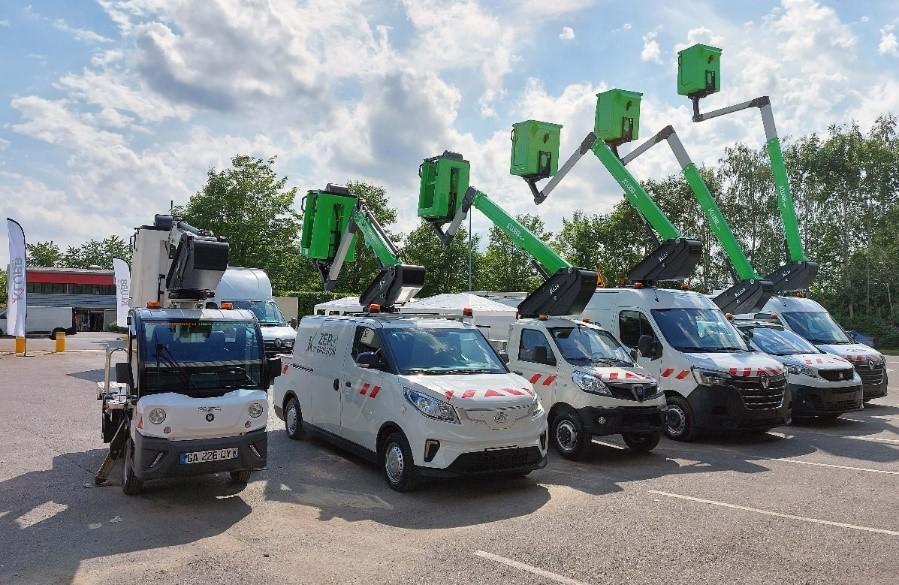
Thanks to their compact dimensions, models such as the KLUBB K20L and KL21B also make it easier to navigate narrow streets and position the vehicle in congested urban environments.
Reducing Disruption to Local Residents
Maintaining a streetlight, replacing a CCTV camera or carrying out work on telecommunications infrastructure can inevitably cause disruption to nearby residents.
By eliminating the need for a combustion engine, electric aerial work platforms reduce vehicle-generated noise. They also produce no exhaust emissions during operation, helping to limit local emissions of nitrogen oxides (NOx) and fine particulate matter from vehicle exhausts.
These benefits are particularly valuable when working near residential properties, shops, healthcare facilities or busy public spaces.
Quieter operation can also give you greater flexibility when scheduling certain maintenance activities early in the morning or during the evening, subject to local regulations.
Naturally, platform movements and the tools used by operators still generate some noise. However, removing combustion-engine noise improves working conditions for your teams while reducing disturbance to local communities.
Improving Productivity Across Multiple Urban Worksites
A typical day of urban maintenance rarely involves a single intervention. Replacing several streetlights, inspecting CCTV cameras or servicing telecommunications equipment requires frequent journeys, vehicle manoeuvres and positioning operations.
Yet your teams' productivity depends just as much on the time spent between jobs as on the work carried out in the platform itself.
The KLUBB K20L, KL21B and KL32 electric aerial work platforms feature an outrigger-free configuration, simplifying certain vehicle positioning procedures. Although this feature is not exclusive to electric vehicles, it can reduce preparation time when carrying out successive interventions, without removing the need for appropriate site safety measures and traffic management.
The interior storage configurations available on certain van-mounted models also allow operators to carry the tools, consumables and spare parts required for their work.
When completing a maintenance route involving several locations, these practical advantages can deliver valuable cumulative time savings.
The objective is to improve efficiency throughout the entire working day, from the moment your teams leave the depot until they return.
Equipment Designed to Meet Evolving Environmental Requirements
Reducing emissions and noise pollution is becoming an increasingly important consideration in equipment procurement policies and urban maintenance contracts.
Since 22 August 2026, provisions of the French Climate and Resilience Act relating to public procurement have strengthened the integration of environmental considerations into contract award criteria and contract performance conditions.
Operating electric aerial work platforms can help you meet the environmental requirements of certain contracting authorities and demonstrate the suitability of your technical resources when submitting tenders.
For local authorities, electrifying their access equipment can also support fleet renewal programmes and policies aimed at reducing the disruption associated with municipal maintenance operations.
In both cases, choosing an electric aerial work platform addresses environmental objectives while meeting practical operational requirements.
Keeping Your Operating Costs Under Control
The purchase price of an electric aerial work platform is only one part of the equation when assessing its economic value. For contractors and local authorities alike, total cost of ownership (TCO) over the equipment's entire service life provides a more meaningful basis for comparison.
Energy expenditure, servicing, insurance, charging infrastructure and periods of downtime all need to be factored into this assessment.
An electric-powered aerial work platform offers potential savings in energy consumption and certain maintenance costs, although these benefits must be considered alongside the initial investment.
Operational Efficiency Also Drives Financial Performance
An aerial work platform suited to your operating conditions, capable of handling successive assignments and carrying the necessary equipment, helps you make better use of your available resources.
Combine these advantages with a machine that minimises unproductive time, and you can potentially reduce the cost per intervention or optimise the budget allocated to your maintenance operations.
Achieving this level of performance nevertheless requires careful equipment selection. Driving range, aerial platform operating cycles and charging arrangements must be compatible with the distances travelled, the duration of your operations and the way your teams organise their working day.
To accommodate these different requirements, we offer several electric configurations, ranging from compact van-mounted platforms to models providing greater working height and horizontal outreach, such as the KL38P or the XTENSO 4 electric truck-mounted aerial work platform, which delivers a working height of up to 21 metres.
Electric Aerial Work Platforms: A New Approach to Urban Operational Efficiency
Every urban maintenance operation presents its own challenges. Reaching the worksite, finding sufficient space to position the vehicle, working close to residential areas and moving on to the next location are all factors that directly influence your teams' productivity.
For contractors and local authorities, the challenge is now to combine technical performance, cost control and environmental requirements. This shift places operational efficiency at the heart of the decision to invest in electric aerial work platforms.
Beyond the technology itself, the true value of access equipment lies in its ability to help your teams work efficiently, safely and reliably, day after day.