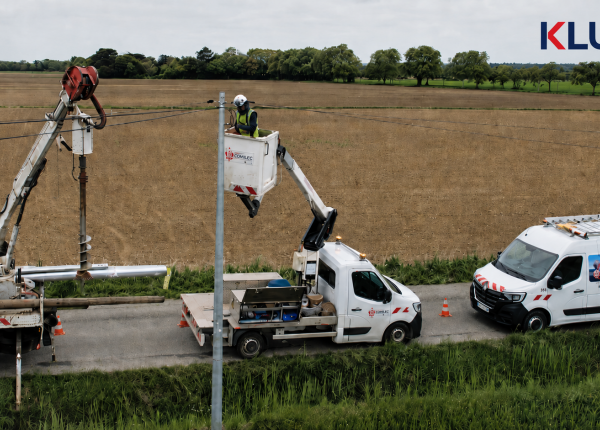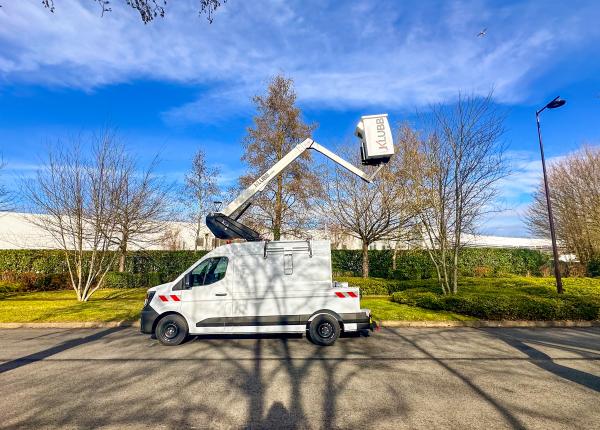







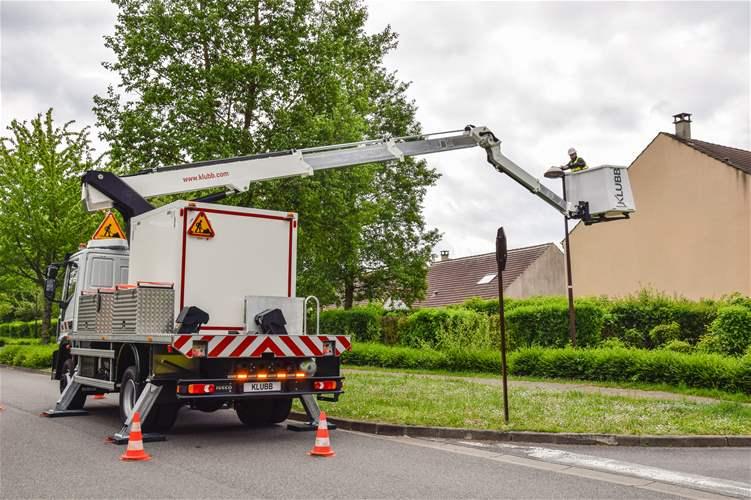
Yes. A workshop body uses part of the vehicle’s available payload because it adds weight to the truck chassis. For operators using a truck-mounted platform every day, that observation does not tell the whole story.
What matters is the payload left once the complete working vehicle has been taken into account: the truck chassis, aerial platform, workshop body, internal fittings, crew and the equipment required for the job.
In practice, the answer depends on two main limits:
- the vehicle’s maximum authorised gross weight;
- the maximum permissible load on each axle.
In the operator documentation for our Xtenso 4 truck-mounted platform, KLUBB specifies that both the total vehicle weight and the distribution of the carried equipment must be checked to prevent axle overload.
This is more relevant than the internal volume of the workshop body. Available storage space does not mean available payload.
How much equipment can you carry?
The best approach is to consider the completed truck-mounted platform in its ready-to-work configuration.
The weight of the bare chassis, or a theoretical figure taken from a manufacturer’s catalogue, is not enough. When the vehicle leaves the depot, it carries its aerial platform, subframe, workshop body, fixed equipment, fluids, crew and the tools and materials required for the assignment.
A useful calculation is:
Remaining payload = maximum authorised gross weight – actual weight of the vehicle in working configuration
This gives a clearer view of the equipment that can still be carried within legal and technical limits.
Gross vehicle weight is the first constraint
Road regulations require the vehicle’s laden weight to remain within its authorised gross vehicle weight. Each axle also has its own maximum permissible load.
The vehicle must therefore be considered in two ways: as a complete unit and in terms of the load carried by each axle.
A large workshop body may have enough room for several hundred kilograms of equipment while the truck has little legal payload left.
By contrast, a well-designed workshop body can provide a high level of operational autonomy while keeping the amount of equipment on board under control.
The key factor is weight, not the number of shelves, cabinets or storage compartments.
Work from the actual configuration of your truck-mounted platform
Available payload depends on the full vehicle specification.
The chassis, aerial platform, subframe, outriggers, workshop body and permanently installed equipment already account for part of the permitted gross weight before any operational equipment is loaded.
KLUBB Xtenso Workshop versions are engineered with these components included in the vehicle configuration from the outset.
The equipment carried for each job must then be added. Depending on the application, this may include:
- the driver and any additional crew members;
- PPE, traffic management equipment and outrigger pads;
- tools and batteries;
- spare parts;
- cables, lighting equipment or network components;
- consumables required for maintenance and installation work.
The payload left depends on both the original vehicle configuration and the equipment carried for each assignment.
Does the workshop body reduce aerial platform performance?
To answer this question, it is important to distinguish between vehicle payload capacity and aerial platform performance.
In KLUBB technical documentation, Workshop and Flatbed versions of the Xtenso 3 and Xtenso 4 truck-mounted platforms are treated as defined machine configurations, with their own general arrangement drawings and working envelopes.
The workshop body is therefore not treated as an additional load fitted to the vehicle after production. It forms part of the engineered configuration.
| Configuration | Working height | Outreach | Platform capacity | Turret rotation |
|---|---|---|---|---|
| Xtenso 3 Workshop | 18.5 m | 13.9 m | 265 kg | 420° |
| Xtenso 4 Workshop | 21 m | 16.5 m | 265 kg | 420° |
The 265 kg figure refers to the rated capacity of the working platform, not to the payload available inside the workshop body.
Workshop body volume is not the same as payload capacity
A workshop body may contain a large amount of unused space even when the vehicle has little payload left.
Cable drums, batteries, lighting equipment, metal components and power tools can add tens or hundreds of kilograms without filling the available storage volume.
For this reason, it is useful to distinguish between permanently carried equipment and job-specific equipment.
PPE, traffic management equipment and tools used every day may remain on board. Spare parts, consumables and equipment for a specific operation can then be loaded according to the planned jobs or route.
This approach limits the amount of stock carried for no operational reason.
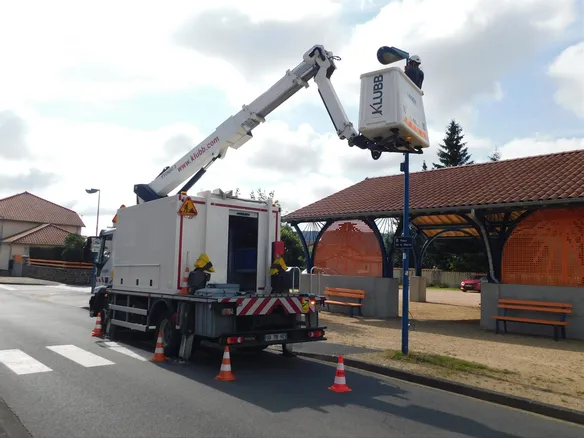
How can a workshop body be designed without using too much payload?
Payload management begins at the vehicle specification stage.
Every cabinet, drawer, shelf or workbench adds weight. The more extensive the internal fit-out, the more payload is used before tools, components or consumables are loaded.
KLUBB therefore adapts the workshop layout to the requirements of each trade.
A public lighting maintenance team, a telecommunications technician and a network maintenance crew do not carry the same components, tools or quantities of equipment.
The aim is to configure a truck-mounted platform whose workshop body reflects the operational needs of the customer while keeping control of both total weight and axle load distribution.
Why choose a workshop body?
Because the operational performance of a truck-mounted platform cannot be measured through remaining payload alone.
A well-specified workshop body allows crews to carry the tools, equipment, spare parts and consumables required for their work while keeping them organised and accessible on site.
Depending on the application, this type of configuration can:
- reduce journeys back to the depot;
- support several interventions during the same route;
- reduce the need for an additional support vehicle.
The truck-mounted platform then performs two functions: safe access at height and a mobile workshop.
The key question becomes:
How much operational autonomy do you need from the equipment carried on your vehicle?
Our role is to design a configuration that balances payload capacity, workshop organisation and the technical constraints of the truck chassis.
So, does a workshop body compromise performance?
A workshop body uses part of the vehicle’s available payload. However, this does not mean a reduction in working height, outreach or platform capacity when the machine has been engineered and approved in that configuration.
For the Xtenso Workshop range, KLUBB documentation identifies the Workshop version as a specific configuration and defines the aerial performance of the complete machine.
For operators, the main constraint is the actual weight of the vehicle in ready-to-work condition and the distribution of that weight across the axles.
Before asking how much equipment will fit inside the workshop body, determine how much legal payload remains.
That answers the question that matters in day-to-day operations:
“Once my truck is fully equipped and ready to leave the depot, how much additional equipment can I still carry?”