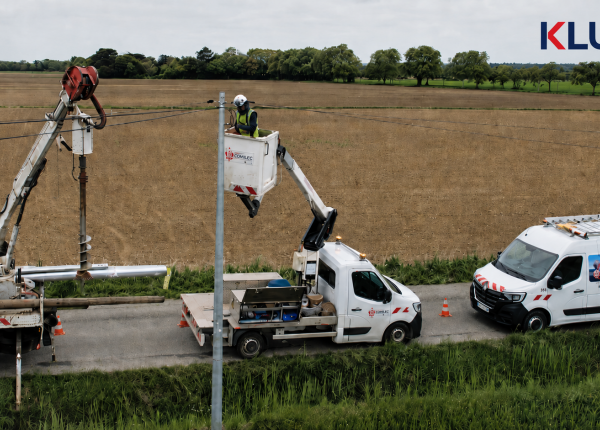






When you factor in narrow streets, traffic density, pedestrians and nearby electrical networks, working at height in urban environments is anything but straightforward. It is a constant balancing act.
As an operator, you also have to work quickly, remain precise and protect both your own safety and that of everyone around you at every stage. These constraints directly affect your organisation and your operational efficiency.
In these situations, working with chassis-mounted platforms, such as truck-mounted platforms, quickly shows its limits. Because of their larger footprint, these aerial platforms take longer to deploy and force you to carry out more manoeuvres once the basket is in position. That is lost time most teams cannot afford.
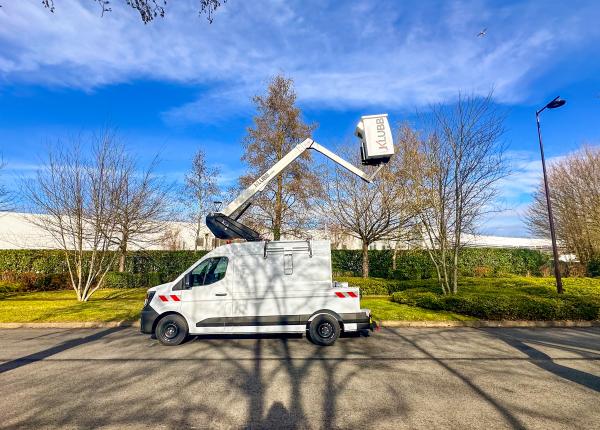
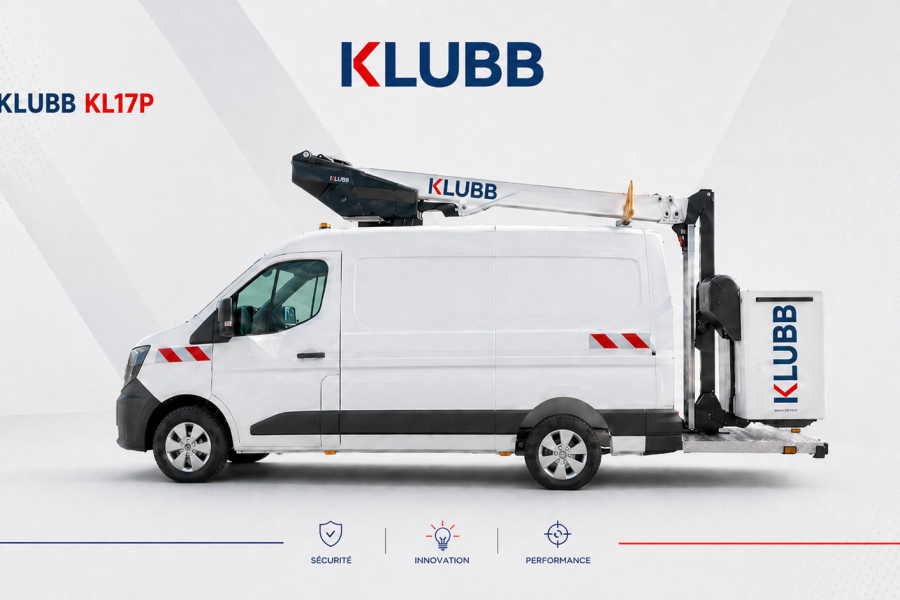
These constraints become far easier to manage when you choose KLUBB’s new KL17P van-mounted platform. Compact and mounted on a Renault Master L2H2 under 3.5 t, it has been designed for fast deployment and real working conditions on site.
When should you choose the KL17P van-mounted platform?
In practice, the KL17P van-mounted platform becomes the obvious choice when mobility and intervention speed are priorities.
For public lighting maintenance or CCTV camera installation, your teams often need to complete multiple operations in constrained environments, with little scope for closing traffic lanes for long periods.
Van-mounted platforms such as the KL17P help reduce set-up constraints while retaining sufficient working capacity for most operations.
Are there alternatives to the KL17P?
There are, of course, several alternatives to the KL17P. Each one responds to a specific operational need. On site, however, the decision depends on the balance you are seeking between compactness, speed of deployment, working height, outreach and ease of movement from one job to the next.
Light truck platforms, for example, are valued for their agility and everyday ease of use. They remain a relevant choice for many working-at-height operations. However, as soon as the requirement becomes more demanding in terms of height or outreach, light vehicle platforms can reach their limits more quickly.
Heavy-truck platforms offer greater working height and outreach than platforms mounted on chassis cabs under 3.5 t. This makes them a robust solution for certain applications, such as work on historic buildings. In return, their size and deployment time can be less favourable in tight urban areas.
Self-propelled platforms also make sense in their own configuration, particularly on fixed sites or in stable environments. They are less suited to situations where teams need to move frequently and work on several successive points.
KL17P. A technical and operational response to real site constraints
A mobile sub-3.5 t format
The sub-3.5 t format of the KL17P provides an immediate response to the constraints your teams face on site. It can be driven with a standard car licence, so you can mobilise crews more easily, without depending on specific driver profiles or additional administrative constraints.
This means more flexibility when organising rounds, especially when you need to respond quickly or reassign a team during the day. You gain responsiveness without making your logistics more complicated.
With a controlled unladen weight of around 3,100 kg with a full tank, this van-mounted platform retains optimised payload capacity. You can carry tools and equipment and work in good conditions, without having to compromise between mobility and load capacity. That balance is rarely achieved in this type of configuration.
Capacity adapted to working teams
On site, coordination, tool handling and area safety are part of everyday work. Working with two people is therefore often essential.
With a basket capacity of 250 kg, the KL17P responds directly to that requirement. Two operators can work at the same time with their equipment, without being restricted in their movements. This directly changes the way interventions can be organised.
Beyond the figure itself, this creates a real efficiency gain. Fewer trips back and forth, less dependency between operators and smoother task execution. Over a full working day, this can represent a significant time saving.
Work at height with precision
Height and outreach adapted to real use cases
The KL17P was not designed simply to go as high as possible. It was designed first and foremost to cover most urban working situations efficiently.
- With a working height of 17.3 m and outreach of up to 10.5 m, it provides access to complex areas without systematically repositioning the vehicle. That is where the real difference is made on site.
- Less repositioning means fewer manoeuvres, less lost time and less fatigue for operators.
- You gain continuity across your interventions.
A trade-focused reading of the machine’s capacities
Beyond raw performance figures, what matters most is how these capacities can be used.
Load chart management allows outreach to be adapted according to the weight in the basket. You can adjust positioning in real time according to the site configuration, while remaining within optimal safety conditions.
This avoids oversizing equipment “just in case”. You work with a machine that matches your real needs and make precise use of its capabilities. This is a more refined, more operational and often more cost-effective approach.
Reduce your intervention cycles with the KL17P van-mounted platform
Encouraging work on wheels
In many situations, especially medium-height operations, deploying stabilisers is not always necessary. In these configurations, the KL17P can work directly on wheels. On site, that changes a lot.
- You reduce set-up phases.
- You limit handling operations.
- You can complete successive interventions more quickly.
On a round involving several work points, the time saving becomes noticeable immediately.
Fast deployment
When the conditions require stabilisation, the KL17P remains consistent with the same speed-focused logic.
Automatic stabilisation allows fast deployment without operator intervention. Everything is designed to simplify set-up and secure the intervention from the first few minutes.
The home function allows the basket to be returned to its initial position in a single movement. It may sound like a small detail, but at the end of an operation, when the next task has to follow quickly, this type of feature makes a real difference.
You save time on every “non-productive” phase, including set-up, stowage and repositioning. Your efforts are therefore focused on what truly matters. The work at height itself.
A van-mounted platform centred on operator safety
On-board technologies
Safety is not only a matter of instructions or procedures. It also depends on the ability of the aerial platform to adapt to the conditions of intervention.
The KL17P integrates on-board technologies designed to support the operator’s decision-making. The IUS system, meaning Intelligent Usage Stability, automatically adjusts outreach according to the vehicle’s slope. You can work without constantly recalculating safety margins.
The moment limiter monitors the machine’s capacities in real time according to load and boom position. It helps avoid risk situations while still allowing the available performance to be used.
The anti-collision system adds further protection in congested environments. When working near obstacles or networks, this kind of assistance quickly becomes essential to avoid handling errors.
Safety at the control station
Beyond on-board technologies, safety also depends on the way the operator interacts with the machine.
The KL17P integrates a capacitive dead-man system, ensuring that movements can only be carried out when the operator is properly in control. This limits the risk of unintended movements, particularly in situations involving fatigue or distraction.
Proportional controls complete the system. Each movement of the platform can be adjusted smoothly. The operator therefore retains fine control of the machine’s movements.
KL17P vs KL42P. The duel between KLUBB’s large van-mounted platforms
On paper, the KLUBB Group KL17P and KL42P belong to the same category. They are compact van-mounted platforms under 3.5 t, designed for urban work.
In practice, however, the two machines do not serve exactly the same operating logic. While the KL42P focuses on compactness and trade-specific integration, the KL17P takes working height and outreach further.
In other words, the choice is not based solely on technical specifications. It depends on how you work every day.
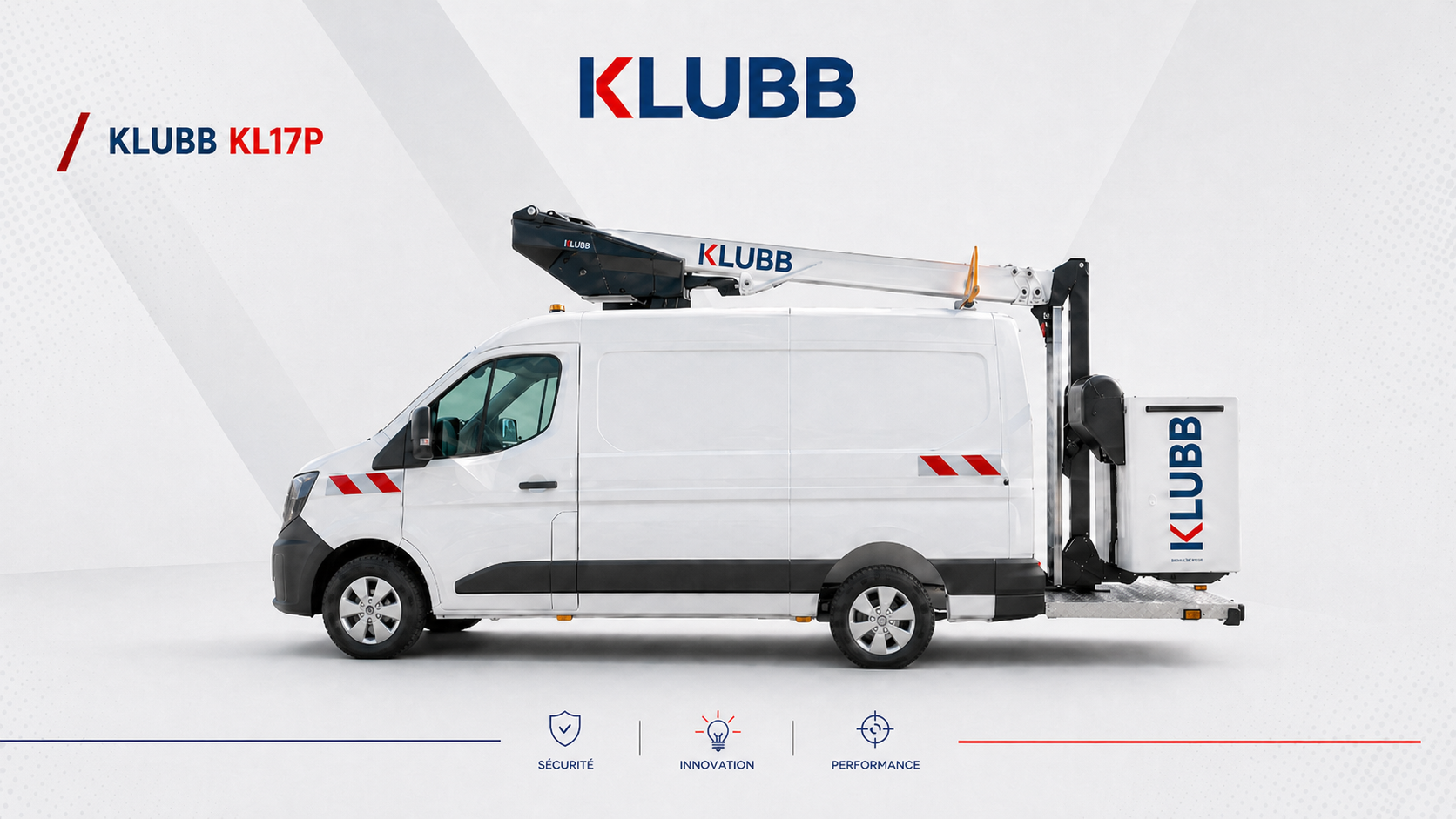
Mobile workshop logic or performance logic
If your activity requires you to carry equipment, organise a genuine working space in the rear of the vehicle and handle recurring operations, the KL42P follows a mobile workshop logic. It combines mobility and organisation, with a working height suited to many everyday interventions.
The KL17P responds to another priority. Going higher and further, with more margin during interventions. With its 17.3 m working height and up to 10.5 m outreach, it covers more demanding configurations without constantly repositioning the vehicle.
Similar capacities but a different level of intervention
The difference between the two models becomes clear in concrete situations.
The KL42P, with its 14.8 m working height and 8.2 m outreach, remains perfectly suited to standard operations, including public lighting maintenance, equipment installation and routine technical interventions.
The KL17P provides additional margin. This difference may seem limited on paper, but on site it can avoid repositioning, help clear certain obstacles and make work more comfortable in complex configurations.
Intervention speed. The point not to underestimate
On repeated interventions, maximum height is not always what makes the difference. The decisive factor is often the time required to get into position.
The KL42P is designed for fast deployment and efficient organisation around the vehicle, particularly in a mobile workshop approach.
The KL17P goes further by integrating features such as automatic stabilisation, the home function and the ability to work on wheels in certain configurations. These elements help reduce intervention cycles and allow operations to follow one another more quickly.
Concrete use case. Public lighting maintenance with the KL17P
Before. An intervention organisation constrained by set-up
In public lighting maintenance operations, a significant share of the intervention time does not relate directly to the technical action on the luminaire, but to set-up phases.
Vehicle positioning, stabiliser deployment when required, securing the working area and adjustments linked to the environment, such as traffic, parking and street furniture, are all necessary stages. They are, however, only slightly productive, if at all.
When several stopping points are required, as is often the case, these phases are repeated at each move. Taken together, they can represent a substantial proportion of the total intervention time.
After. Set-up that can be simplified depending on the configuration
In this type of context, using a telescopic van-mounted platform such as the KL17P can simplify these deployment phases in certain configurations.
The compactness of the vehicle makes positioning easier in constrained urban environments. In addition, the ability to work with or without stabilisers, depending on working height and intervention conditions, can reduce the systematic use of certain deployment stages.
When stabilisation is required, the automatic stabilisation system helps standardise and accelerate this phase. The home function also makes it easier to stow the boom at the end of an intervention, helping to reduce transition times between two points.
These elements do not remove all site constraints, but they can help reduce their operational impact.
What can change across a full intervention round
On operations involving several intervention points, reducing set-up and stowage phases can improve work continuity.
In certain configurations, this can help you.
- Reduce non-productive time between two interventions.
- Smooth the sequence of operations.
- Limit repetitive handling tasks for operators.
From a safety perspective, reducing ground handling and using on-board assistance systems can also help keep risks under better control in open environments.
From an ergonomic perspective, simpler deployment and intuitive controls improve working conditions, especially during repeated operations.
What return on investment can you expect from the KL17P?
Purchase price is often discussed. Real operating cost is discussed far less. Yet profitability is decided on site.
A 3.5 t platform such as the KLUBB Group KL17P is not justified solely by its technical specifications. It is justified by what it enables your teams to do more quickly, more simply and with fewer everyday constraints.
Operational gains
In practice, intervention cycles concentrate a large share of time losses.
Every set-up phase, every repositioning task and every unnecessary handling operation slows the intervention down. Taken individually, the impact may be limited. Repeated several times a day, it becomes significant.
With a platform such as the KL17P, the reduction in these cycles is immediate. Work on wheels in certain configurations, automatic stabilisation when required and fast stowage with the home function all help save a few minutes on each intervention.
Across a full day, those minutes can become additional interventions.
Another point is often underestimated. Team mobilisation. A machine that is easier to deploy and faster to set up can reduce the resources required around the worksite. Less coordination, less waiting and more efficiency.
Resource optimisation
Beyond time saved, the whole organisation evolves.
A 3.5 t van-mounted platform such as the KL17P offers a level of versatility that covers a wide variety of interventions with a single piece of equipment. You therefore avoid multiplying specialised machines for occasional needs.
In some cases, this can even help rationalise the equipment fleet. Fewer machines to manage, less maintenance and fewer indirect costs, while retaining high intervention capacity.
This logic is particularly relevant for organisations carrying out varied assignments, with constraints that change from one site to another.