






To answer that, distinguish between the equipment’s history and the work you are about to ask it to do. The last inspection took place while the machine was in service with its previous owner. Now it is joining your fleet. You need to check that the inspection record is current, review any defects and repairs, and confirm that the MEWP is suitable for the tasks and conditions at your sites.
Within the EU and EEA, Directive 2009/104/EC sets minimum requirements for the inspection and maintenance of work equipment. It requires initial inspections where safety depends on installation, periodic inspections where use may cause dangerous deterioration, and special inspections after certain exceptional events. National laws and practice set the detailed arrangements, so inspection intervals and procedures vary. Countries outside this framework may have different requirements.
|
Inspection point |
When does it apply? |
What does it establish? |
|
Initial / installation inspection |
After installation and before first use when safety depends on installation; after assembly at a new site or location in the same circumstances. |
The equipment has been installed correctly and is operating properly. |
|
Periodic inspection |
For work equipment exposed to conditions that could cause dangerous deterioration; intervals and procedures are set by national rules and practice. |
Deterioration is detected and addressed before it creates a dangerous situation. |
|
Special inspection |
After exceptional circumstances that may jeopardise safety, such as modification work, an accident, natural events or prolonged inactivity. |
The equipment remains safe following the event; any further checks or tests are identified. |
Three inspection points in a MEWP’s working life
Before first use: does installation affect safety?
A vehicle-mounted MEWP is an integrated assembly. As the platform moves away from the van, forces pass through the boom, its joints, the turret and its fixings to the chassis, then through the supports to the ground. The vehicle, lifting equipment and stabilisation system must work together in the configuration supplied. If safe operation depends on how the equipment is installed, the European framework requires an initial inspection after installation and before first use.
The same principle applies after the equipment is assembled at a new site or location. The Directive requires a competent person, as defined by the national rules or practice, to check that the equipment has been installed correctly and operates properly. For a vehicle-mounted platform that remains assembled on its carrier, this does not automatically mean a new inspection every time the vehicle is parked. The key question is whether safety depends on the installation or set-up conditions.
A first-use inspection is not the only check to make. Review the manufacturer’s instructions, the conformity and inspection documents, the vehicle and platform configuration, and the work planned. Does the platform have the reach and capacity needed for the task? Can the vehicle be positioned safely, with enough room for the outriggers if they are required?
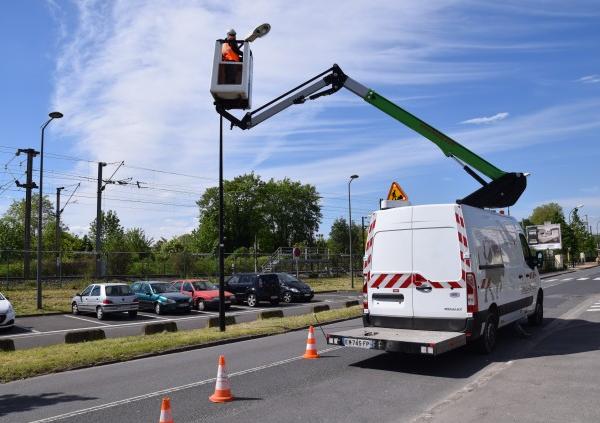
For example, the technical specifications for our KL17P vehicle-mounted platform give a maximum working height of 17.30 m and maximum outreach of 10.50 m. To find the outreach available at the height of a streetlight, consult the working envelope diagram. Vehicle inclination also matters: on this model, the IUS system measures it and adjusts the available outreach. The set-up position therefore affects whether the technician can reach the work area safely.
Buying a second-hand MEWP: what does the previous inspection report tell you?
Let’s return to the van. The latest inspection report records the examiner’s findings at that time. If it noted play in a joint, for example, the maintenance log can show what work has since been completed. When taking delivery of used equipment, read the inspection report alongside repair records and the manufacturer’s instructions. A recent report does not, by itself, establish that the machine is suitable for your intended work or that it remains safe today.
The European framework requires inspection results to be recorded and retained for an appropriate period. When work equipment is used outside the undertaking, it must be accompanied by evidence that the last inspection has been carried out. Before putting a second-hand MEWP to work, check the applicable national requirements, the date and scope of the last inspection, any outstanding defects, and whether a further inspection is due.
Information note — If you hire the MEWP
When hired equipment is used outside the undertaking, the European framework requires it to be accompanied by evidence of its most recent inspection. Ask the hire company for the relevant inspection record and check that any reported defects have been addressed. The operator’s manual and the equipment’s maintenance and inspection history should also be available to the people who plan and use the machine.
While the MEWP is in service, inspections follow its risks and national rules
The European Directive requires periodic inspections for equipment exposed to conditions that could cause dangerous deterioration. It does not set one six-month interval for every vehicle-mounted MEWP across Europe. Your country’s rules, the equipment’s use, the manufacturer’s instructions and the competent person’s assessment determine the required interval and scope. Track the due date specified for the machine in the country where it is operating.
What should an inspection cover? First, the MEWP’s condition. A deformed outrigger, a visible crack near a fixing or unusual play in a pin are signs that need investigating. On a vehicle-mounted platform, pay particular attention to the connections between the lifting equipment and the chassis. They carry the forces generated when the boom is working at outreach. The inspection must be carried out by a person with the competence required under the applicable national rules and practice. IPAF’s guidance on MEWP inspections provides industry resources on inspection competence and practice.
The inspection may also include functional checks. A crack may be visible when the machine is stationary; a functional check helps establish whether a device stops a movement, holds a position or responds as intended. The scope depends on the equipment, the manufacturer’s instructions, the risk and the applicable national requirements. For MEWPs, this may include checking the operation of safety devices and, where fitted, load or moment limiters. IPAF’s inspection guidance provides further MEWP resources.
Technical note — Does every inspection require a load test?
No single test programme applies to every MEWP across Europe. The European Directive provides for periodic inspections and, where appropriate, testing by competent persons under national laws or practice. A static or dynamic load test should not be assumed to be part of every inspection. If you compare an inspection quote with a repair quote, check exactly what each one covers. IPAF’s inspection and maintenance guidance
explains the different roles of pre-use checks, scheduled maintenance and periodic inspections.
After a repair or an unusual event, what should happen before work resumes?
Your van returns from the workshop on a Friday. A team is waiting for it on Monday morning. Before putting it back on the schedule, read the work report: what have the technicians repaired or changed?
Routine maintenance and a safety-critical repair are not the same. The European framework calls for a special inspection after exceptional circumstances that may have jeopardised the safety of work equipment. Examples include modifications, accidents, natural events and prolonged periods out of use. A repair to a structural part of the boom may affect safety, so ask a competent person whether a special inspection or testing is required before the MEWP returns to work.
The inspection should address the risks created by the repair or event. Depending on what was affected, the competent person may need to examine the repaired component and its connections to the rest of the assembly, review the manufacturer’s instructions and carry out functional checks or tests. There is no European rule requiring the same set of static and dynamic tests after every repair; the scope depends on the equipment, the work completed and applicable national requirements.
What if the lifting equipment is transferred to a different vehicle? The boom may keep the same serial number while its fixings, mounting geometry and stability conditions change. Before going ahead, ask the manufacturer or integrator to confirm whether the proposed configuration is approved, what documentation covers it and what inspections or tests are needed. The previous report describes the machine as it was installed on the original vehicle; it does not confirm the safety of the new assembly.
When moving between jobs, does the MEWP need another inspection?
A street-lighting team may move its van several times during the day. Does each move call for another inspection, or does the answer depend on how the platform is installed and set up?
The European framework does not impose a new inspection simply because a vehicle-mounted MEWP travels to another job. It does require an inspection after assembly at a new site where the equipment’s safety depends on its installation conditions. National rules may add requirements, so check the rules that apply where the MEWP is being used.
At every new work position, the ground and set-up still need to be assessed. In the morning, the vehicle may be on a level road; in the afternoon, beside a verge built on fill. The machine’s configuration may be unchanged, but the ground’s ability to support an outrigger can be very different. IPAF’s guidance on ground conditions and supporting structures recommends checking the ground beneath each support point, the slope, nearby excavations or underground services, and the space needed to deploy the outriggers in line with the manufacturer’s instructions.
Before handing over the keys, read the inspection record alongside the MEWP’s history
To decide whether a MEWP can return to work, read its inspection report, maintenance log and manufacturer’s instructions together. The inspection report records the examination and any findings. The maintenance log tracks work carried out on the machine. The instructions identify approved configurations, set-up requirements and operating limits. The European framework requires inspection results to be recorded and retained, with evidence of the last inspection accompanying equipment used outside the undertaking. IPAF’s guidance also distinguishes periodic inspections from scheduled maintenance.
If an inspection report identifies a defect and a workshop carries out a structural repair, confirm what changed and whether a competent person considers the MEWP safe. Before work resumes, check whether national rules require a special inspection or test.