





On paper, choosing a van-mounted platform may seem more straightforward than selecting a chassis-mounted platform or a truck-mounted platform. In practice, however, the decision is still a demanding one.
A van-mounted platform has to meet several requirements at once. It must, of course, allow operators to work safely at height. But it must also be easy to drive, able to carry equipment, protect tools, adapt to daily routes and remain practical for the operators who use it every day.
Most of the time, the choice of a van-mounted platform focuses on three criteria. People first look at working height, then outreach, and finally basket capacity, assuming that everything is under control. These criteria do matter, but they often come too early in the decision-making process.
A model may look perfectly suitable on a specification sheet, yet prove less appropriate during the first few jobs. It is always out in the field that you realise storage space is lacking, working outreach is too limited, or the vehicle’s overall size makes it difficult to manoeuvre through certain streets.
To make the right choice, we recommend starting instead with how you intend to use the platform. Your trade, your work sites, your access constraints and your day-to-day organisation should guide the decision before you turn to the technical data.
1. Choose your van-mounted platform according to your trade
The first question to ask yourself is: “What will my van-mounted platform mainly be used for?”
That is the real starting point. Before discussing working height, outriggers or payload, you need to understand the job the vehicle will be required to perform.
A telecoms team will not have the same needs as a public lighting department. A local authority working across several sites in a single day will not face the same constraints as a contractor spending several hours in one industrial area.
Your field of work provides the first clear direction.
It helps you anticipate the equipment to be carried, how often the van-mounted platform will be used, how many operators will be involved and what type of asset or installation needs to be accessed.
For telecoms network maintenance, the vehicle will often need to carry cables, junction boxes, measuring devices, connection tools and PPE. For public lighting maintenance, the utility van will act as a storage area for light fittings, traffic management equipment, small tools and sometimes bulkier spare parts.
Your trade shapes the choice before you even read the technical specification sheet.
This point matters. A clear understanding of your work is what prevents you from choosing a model that looks attractive on paper, but proves poorly suited to your real-life operations.
2. Identify your work location and operating conditions
You now need to consider where the van-mounted platform will be working.
This is not always straightforward either, and it deserves proper thought. A vehicle-mounted platform used in a city centre does not face the same constraints as a model intended for residential areas or departmental roads.
Try answering this question and the choice will become clearer: “What parking and manoeuvring conditions will the van-mounted platform have to deal with?”
- Narrow streets,
- cluttered pavements,
- set-back façades,
- awkward parking,
- busy roads,
- restricted access,
- occupied car parks.
All of these factors influence the choice of vehicle.
For mainly urban use, at KLUBB we consider vehicle manoeuvrability to be a priority. The vehicle must be able to move, park, set up and leave without making the job more complicated. On sites with obstacles, outreach becomes more important. On public roads, deployment speed and traffic management also come into the equation.
The right model is the one that can be positioned in the right place, under the conditions your teams actually face.
3. Choose the right working height
Working height remains a key selection criterion, as it is the central technical feature of an aerial work platform. In our view, however, it needs to be approached methodically.
We would advise against focusing first on the maximum working height available on a given van-mounted platform model. It is better to ask yourself: at what working height will you be operating in 80% of your jobs?
Once again, real site conditions should guide your thinking.
If your teams most often work between 10 and 13 metres, it is not always relevant to aim much higher. An oversized model may cost more, create additional operating constraints and lose coherence with your daily routes.
A model that is too limited, on the other hand, can quickly become a problem.
Being short by just a few dozen centimetres may be enough to make access difficult. Above all, look for the right balance.
Your van-mounted platform must cover your everyday requirements while keeping a useful margin for more occasional jobs. Maximum height matters, but the height you actually use matters more in the final choice.
4. Assess the outreach you need
Outreach is one of the most important criteria when choosing a van-mounted platform.
In our experience, however, it is often considered only after working height.
On site, the vehicle cannot always be positioned directly beneath the work area. A parked car, a pavement or a traffic lane, for example, may prevent the vehicle from being placed exactly where you would like it.
You therefore need to ask yourself whether your future van-mounted platform will always be able to park directly below the area to be reached.
If your immediate answer is no, then outreach becomes decisive.
Good outreach allows the basket to reach an area located away from the vehicle. This is particularly useful for telecoms network maintenance, CCTV camera maintenance, and public lighting installation or maintenance work.
The horizontal outreach provided by the aerial work platform also gives you greater flexibility when organising the job:
fewer repositioning manoeuvres
fewer vehicle movements
a better ability to work from a safer position
5. Check the basket load capacity
This is an important reminder. When we talk about basket load capacity, we are, of course, including the weight of the operator or operators. But we are also including the weight of the equipment they take with them to carry out the job.
An operator rarely works empty-handed. They may need tools, consumables, cables, boxes, measuring devices, light fittings, cameras or replacement parts.
For some work-at-height operations, one operator is enough. For others, two operators are required. That configuration immediately changes the load capacity requirement.
You should also consider the type of task being carried out. A simple visual inspection does not create the same constraints as replacing equipment or carrying out a connection operation.
If the basket load capacity is too low, operators will quickly be forced into repeated trips to collect additional equipment. Over time, this can make jobs that should remain straightforward unnecessarily complicated.
Conversely, choosing a higher load capacity without a clear reason may push you towards a configuration that is less suited to the rest of your requirements.
The right approach is to ask yourself:
who will be going up in the basket?
with what equipment?
for what type of operation?
6. Analyse the need for stabilisation
Stabilisation has a direct impact on how the van-mounted platform will be used.
Some models prioritise rapid deployment. Others provide reinforced ground support through stabilisers. In this respect, there is no inherently right or wrong answer. The right choice depends mainly on the pace, location and type of work being carried out.
For short, frequent and repetitive stops, rapid deployment can be highly valuable. This is particularly true when the vehicle carries out several jobs in a single day, with relatively short working times at each stop.
For longer operations, however, involving greater outreach or more complex working conditions, a van-mounted platform fitted with stabilisers may be the better option.
7. Check the remaining payload and the space you can actually use
In our view, a van-mounted platform must combine the specific requirements of working at height with the practical needs of your trade.
Once the platform has been integrated, it is not enough to look at working height, outreach or basket capacity. You also need to check that the vehicle still allows your teams to carry, organise and use their equipment on a daily basis.
Your teams must be able to load all the equipment required for their work, from the smallest items to the bulkiest components. If the remaining payload is too limited, the van loses part of its value.
Interior volume plays an equally important role here. Depending on the utility vehicle model selected, the available rear space may vary. You therefore need to check whether there is still enough room to install shelving, drawers, lockers or supports.
A well-designed van works like a mobile workshop. Tools are easy to access. Parts are protected. Equipment remains organised. Operators can prepare their jobs more easily and save time between sites.
If the space is poorly designed, the time lost on each job quickly becomes significant. Not to mention the loss of operational efficiency and the cost this can create.
9. Use a selection matrix to compare models
Once all the criteria have been identified, comparison becomes much clearer.
The aim is not to select the highest or most impressive model. The objective is to choose the one that best matches your real operational use.
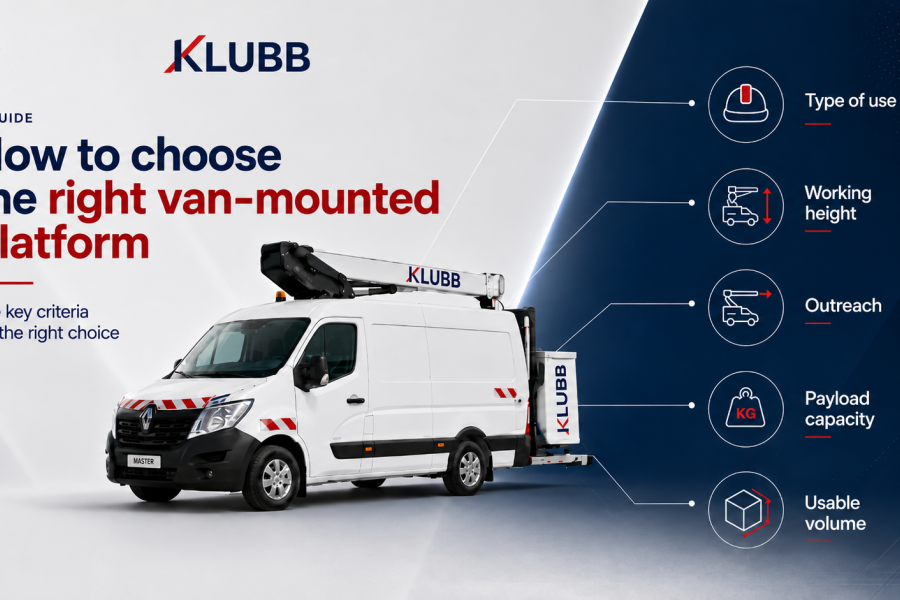
Here is a simple matrix to help structure your decision.
| Criterion | Decisive question |
| Field of application | What trade will the vehicle be used for |
| Work location | What environment will it be working in? |
| Working height | What height is actually useful? |
| Outreach | Does the basket need to work away from the vehicle? |
| Basket capacity | What load needs to be lifted at height? |
| Stabilisation | Should you prioritise rapid deployment or reinforced stability? |
| Payload | What equipment needs to remain on board? |
| Operation | Is the model easy to maintain and make profitable? |
10. Which KLUBB van-mounted platform should you consider for your needs?
At KLUBB France, not all our van-mounted platform models are designed for the same uses. Our approach is not to point you towards a single model, but to help you identify the configuration that best fits your trade.
For fast urban operations, consider the KL21B
If your teams mainly work in urban areas, on short, repetitive and relatively light-duty jobs, the KL21B may be a relevant option.
This 100% electric van-mounted platform offers a working height of 11.40 m, a maximum outreach of 6.50 m and a basket capacity of 120 kg for one person. It is therefore well suited to light-duty operations, dense urban areas, routine maintenance work, and sites where noise and emissions need to be kept to a minimum.
For a good balance between height, outreach and mobile workshop capacity, consider the KL32
If your teams need a versatile van-mounted platform, with genuine storage capacity and a working height suited to many urban jobs, the KL32 becomes particularly relevant.
It reaches a working height of 12.50 m and an outreach of 7.30 m, without stabilisers, with a basket capacity of up to 120 kg or 200 kg depending on the configuration. KLUBB also presents it as an interesting model for telecoms, public lighting, CCTV and construction work.
For greater outreach requirements, consider the KL17P
When your teams cannot always position the vehicle directly beneath the work area, outreach becomes a priority criterion.
This is often the case with set-back façades, hard-to-access electrical networks, equipment positioned above obstacles, or jobs where parking constraints force the vehicle to work from an offset position.
In these configurations, the KL17P comes into its own. It offers a working height of 17.30 m, up to 10.50 m of outreach, 420° basket rotation, and a basket capacity of 120 kg for one person or 200 kg for two people. It remains mounted on a vehicle with a GVW of 3.5 tonnes or less.
The right reflex before choosing
Before requesting a quote, start with your dominant use case.
- For light urban operations, the KL21B may be a coherent choice.
- For a balance between height, storage and versatility, the KL32 is worth considering.
- For more complex access conditions requiring greater outreach, the KL17P becomes more suitable.
Bear in mind that the most profitable van-mounted platform will always be the one that allows your teams to arrive on site, park correctly, reach the work area, access the right equipment and move on to the next job without wasting time.
Need help choosing your van-mounted platform?
Choosing a van-mounted platform means starting from your real-life operations. Your trade, your work locations, your access constraints, your onboard equipment and your field organisation should guide the choice before you even start comparing technical specification sheets.
Are you hesitating between several models or configurations? The KLUBB France teams can help you identify the van-mounted platform best suited to your needs, whether the key issue is working height, outreach, payload, interior fit-out or maintenance.