






Reaching significant working heights in urban environments without requiring an HGV driving licence is one of the main advantages of aerial work platforms mounted on chassis with a gross vehicle weight of 3.5 tonnes or less.
However, selecting the right machine requires careful consideration of its overall dimensions, manoeuvrability and positioning requirements, alongside a working envelope capable of accommodating your operations.
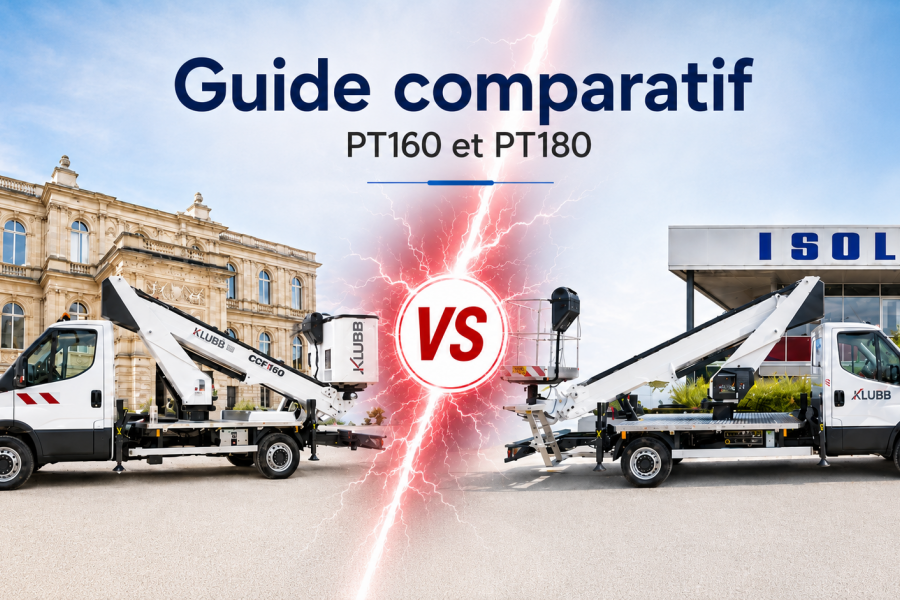
To help you make an informed decision, we compare two of ISOLI's most representative models in this category: the PT160 E H-H and the PT180 E H-H.
At first glance, their technical specifications appear remarkably similar. A closer examination of their working diagrams, however, reveals some significant differences. Working height, horizontal outreach and platform load capacity must be assessed together to determine which model is best suited to your requirements.
For a consistent comparison, we have selected the PT160 E H-H and PT180 E H-H configurations mounted on an Iveco Daily chassis and equipped with H-type outriggers.
PT160 vs PT180: Two aerial work platforms with similar specifications at first glance
Both light vehicle-mounted aerial work platforms share several technical characteristics, including a maximum platform load capacity of 300 kg, 360° turret rotation and platform dimensions of 125 × 75 × 110 cm.
Their main differences become apparent when examining their respective working envelopes:
- The PT160 offers a working height of 16 m and a stated maximum horizontal outreach of 10.5 m.
- The PT180 provides a working height of 18 m and a stated maximum horizontal outreach of 12.5 m.
Choosing between the two therefore involves considerably more than comparing working heights of 16 m and 18 m. You must also consider the distance between the vehicle and the intended working position, the load carried in the platform and the space available to position the vehicle safely.
| Technical specification | PT160 E H-H | PT180 E H-H |
|---|---|---|
| Working height | 16 m | 18 m |
| Platform height | 14 m | 16 m |
| Stated maximum outreach | 10.5 m | 12.5 m |
| Maximum platform capacity | 300 kg | 300 kg |
| Turret rotation | 360° | 360° |
| Platform dimensions | 125 × 75 × 110 cm | 125 × 75 × 110 cm |
| Outriggers | 4 H-type outriggers | 4 H-type outriggers |
| Gross vehicle weight | ≤ 3.5 tonnes | ≤ 3.5 tonnes |
| Overall length on Iveco Daily | 6,573 mm | 7,531 mm |
| Wheelbase | 3,750 mm | 3,750 mm |
The installation specifications indicate an overall vehicle length of 6,573 mm for the PT160, compared with 7,531 mm for the PT180 — a difference of 958 mm.
On paper, the PT180 therefore provides an additional 2 m of working height and 2 m of maximum horizontal outreach. The PT160, meanwhile, retains a shorter overall vehicle length, potentially making it better suited to operations in confined urban environments.
Why working height should not be your only selection criterion
When choosing between the PT160 and PT180, working height should never be considered in isolation.
If your operations require access to a point 17 m above ground level, the PT180 is the logical choice. However, even when working at heights of 12 or 13 m, the most suitable machine may depend on how far the vehicle must be positioned from the intended working area.
Two measurements are therefore essential:
- The height of the intended working position.
- Its horizontal distance from the stabilised vehicle.
Together, these measurements establish whether the intended working position falls within the machine's accessible working envelope.
However, a third factor must also be considered: the load carried in the platform.
Working height, outreach and platform load: Three essential factors in selecting the right machine
The PT160's stated maximum outreach of 10.5 m and the PT180's 12.5 m represent the outer limits of their overall working envelopes. These figures do not mean that such distances can be achieved in every configuration with a platform load of 300 kg.
The working diagrams for both models show that their accessible envelopes vary according to the load carried.
Your intended working position must therefore fall within the working envelope corresponding to the actual load in the platform.
Which light vehicle-mounted telescopic platform is best suited to your operations?
Choosing between the PT160 and PT180 should begin with an assessment of the conditions you encounter on site.
Required working height, distance from the vehicle, number of operators, tools and equipment carried in the platform, and available vehicle positioning space can all influence your decision.
Scenario 1 – Your operations remain comfortably below 16 m
If your operations fall within the PT160's working envelope and the vehicle can be positioned sufficiently close to the intended working area, this model may meet your requirements without the additional capabilities offered by the PT180.
The objective is not necessarily to select the machine with the greatest working height or maximum outreach. Instead, it is to identify the platform whose capabilities genuinely match your operating conditions.
The PT160 is particularly worth considering when:
- Your intended working positions remain within its accessible working envelope.
- You can position the vehicle close to the working area.
- You rarely require additional working height.
- Its shorter overall length makes positioning easier on your sites.
Scenario 2 – You work below 16 m but must position the vehicle further away
Your intended working height may fall within the capabilities of both the PT160 and PT180, while site conditions require the vehicle to remain several metres away from the working area.
Obstacles, inaccessible ground or site layout may prevent you from positioning the vehicle closer.
It would nevertheless be misleading to assume that the PT180 is automatically the better option simply because its stated maximum outreach reaches 12.5 m.
The working diagrams demonstrate that both machines perform differently depending on the platform load and the required working height.
With a platform load of 200 kg, for example, a working position at 9 m in height and 7 m of horizontal outreach falls within the PT160's reference working envelope. For the PT180, the corresponding 200 kg reference point is located at 11.5 m in height and 6.5 m of horizontal outreach.
The practical question is therefore straightforward: do you primarily need to reach further horizontally, or maintain greater working height as you move away from the vehicle?
Comparing both working diagrams will help determine which model is better suited to this type of operation.
Scenario 3 – You regularly work between 16 and 18 m
When your operations frequently require working heights above 16 m, the PT180 becomes the model to consider first.
It provides a maximum working height of 18 m and a platform height of 16 m, compared with 16 m and 14 m respectively for the PT160.
The PT180 may also be particularly relevant if your operations regularly take place near the upper limit of the PT160's capabilities.
The additional two metres provide greater vertical reach, although this advantage must always be assessed alongside the horizontal outreach and platform load required for each operation.
Scenario 4 – You work with two operators and their equipment
Both models can accommodate a maximum platform load of 300 kg. However, this maximum capacity does not mean that their entire working envelopes remain accessible at this load.
With two operators and their tools, up to a maximum combined load of 300 kg, the available technical data indicates very similar performance at one of the reference points examined:
- PT160: 13 m in height and 5 m of outreach.
- PT180: 12.5 m in height and 5 m of outreach.
At a platform load of 200 kg, the differences become more pronounced:
- PT160: 9 m in height and 7 m of outreach.
- PT180: 11.5 m in height and 6.5 m of outreach.
At these reference points, the PT160 offers slightly greater horizontal outreach, while the PT180 provides an additional 2.5 m of working height.
This illustrates why examining the working diagrams provides a much clearer understanding of operational capabilities than comparing headline specifications alone.
Scenario 5 – You work alone and require extended horizontal outreach
As the platform load decreases, the accessible working envelope expands.
With one operator and equipment weighing up to 150 kg in total, the PT160 can reach a reference point at 8 m in height and 9.5 m of horizontal outreach.
At a load of 120 kg, its working diagram indicates a reference point at 6 m in height with 10.5 m of outreach.
The PT180 offers a different operating profile.
With a platform load of 120 kg, its working envelope includes a reference point at 10 m in height and 8.5 m of outreach.
At 100 kg, the corresponding reference point reaches 9 m in height and 9 m of outreach.
The PT160 can therefore be an attractive option when extended horizontal outreach is required at relatively modest working heights.
The PT180, on the other hand, offers greater working height at some points when operating with substantial horizontal outreach.
Once again, neither model is inherently superior in every situation: the actual geometry of your operation is what determines the most suitable machine.
Scenario 6 – Vehicle positioning space is limited
When mounted on an Iveco Daily chassis, the PT160 has an overall length of 6,573 mm, compared with 7,531 mm for the PT180.
In the configurations examined, the PT160 is therefore 958 mm shorter.
If its working envelope already meets your requirements, this difference may be particularly valuable when operating on sites where vehicle positioning space is restricted.
The PT180 requires more room to accommodate its greater overall length, but offers a larger working envelope in terms of height.
Your decision will depend on the balance you need to achieve between vehicle dimensions and operational reach.
Scenario 7 – Your operating conditions vary considerably between sites
If your working conditions change regularly, your equipment requirements may also differ from one site to another.
Required working height, distance from the vehicle, platform load and available positioning space will not necessarily remain consistent.
Under these circumstances, the PT180 may offer greater operational flexibility thanks to its higher maximum working height and more extensive overall working envelope.
However, the PT160 remains a perfectly suitable option when most of your operations already fall within its capabilities, particularly where certain tasks primarily require horizontal outreach at moderate heights.
The most effective approach is to assess your recurring operating requirements rather than focusing exclusively on exceptional situations.
PT160 vs PT180: Summary of recommended applications
| Your operating requirements | Model to consider | Reason |
|---|---|---|
| Working comfortably below 16 m with the vehicle positioned nearby | PT160 | Its working envelope may already meet your requirements |
| Regular operations between 16 and 18 m | PT180 | Greater working height |
| Extended horizontal outreach at moderate heights | Compare working diagrams | The PT160 may offer an advantage at certain reference points |
| Maintaining working height at extended outreach | Consider the PT180 | Greater vertical reach at several load configurations |
| Two operators with tools and equipment | Compare both working envelopes | Performance varies significantly according to platform load |
| Restricted vehicle positioning space | PT160, provided its envelope is sufficient | Overall vehicle length is 958 mm shorter |
| Highly variable operating conditions | Compare the complete working envelopes | The best choice depends on your most frequent operational requirements |
PT160 or PT180: Which light vehicle-mounted aerial work platform should you choose?
The PT160 may be the most appropriate choice when its working envelope already covers your typical operations, when vehicle compactness is a priority or when you require substantial horizontal outreach at relatively moderate working heights.
The PT180 becomes more attractive when your operations regularly demand greater working height or when you need to maintain significant vertical reach while operating further away from the vehicle.
Ultimately, the right machine is the one whose working envelope accommodates the combination of height, horizontal outreach and platform load that your operations most frequently demand.