






Planning, inspections, set-up, emergency recovery and record-keeping: a practical approach for professionals already experienced in working from mobile elevating work platforms.
A job involving a mobile elevating work platform (MEWP) does not begin when you deploy the outriggers or when the basket leaves the ground. A substantial part of the work takes place beforehand: establishing whether the MEWP selected is genuinely suited to the task and the conditions in which it will operate.
A machine may be properly maintained, have up-to-date inspection records and be entrusted to a trained, competent operator. All of these are essential, yet none establishes, on its own, whether the equipment can be used safely and effectively at a particular site. The working height and outreach required, ground-bearing capacity, space available for the carrier vehicle, traffic, obstacles and emergency recovery arrangements can all fundamentally affect the operation.
This is precisely where a MEWP job pack proves its worth. Neither the European regulatory framework nor international MEWP guidance prescribes one universally named 'job pack'. They do, however, establish requirements and good practices covering risk assessment, safe selection and use, inspections, instruction and training. A coherent job pack brings the relevant information together without replacing any records or approvals required locally.
Within the European Union, Framework Directive 89/391/EEC places risk prevention and worker information at the heart of workplace safety, while Directive 2009/104/EC addresses the safe selection, use, inspection and operation of work equipment. Internationally, ISO 18893:2024 and IPAF guidance provide a practical framework for reassessing MEWP operations as tasks and sites change. The specific legal duties, inspection intervals and documentary requirements must still be checked in the country of operation.
The aim, then, is not to add yet another document to the job. It is to provide a sufficiently robust framework to ensure that no factor capable of changing the conditions of use is overlooked.
Separate machine-specific information from site-specific requirements
A procedure will only be followed consistently if it is proportionate to the work being undertaken. There is little value in repeatedly entering information that is already known and remains unchanged from one job to the next.
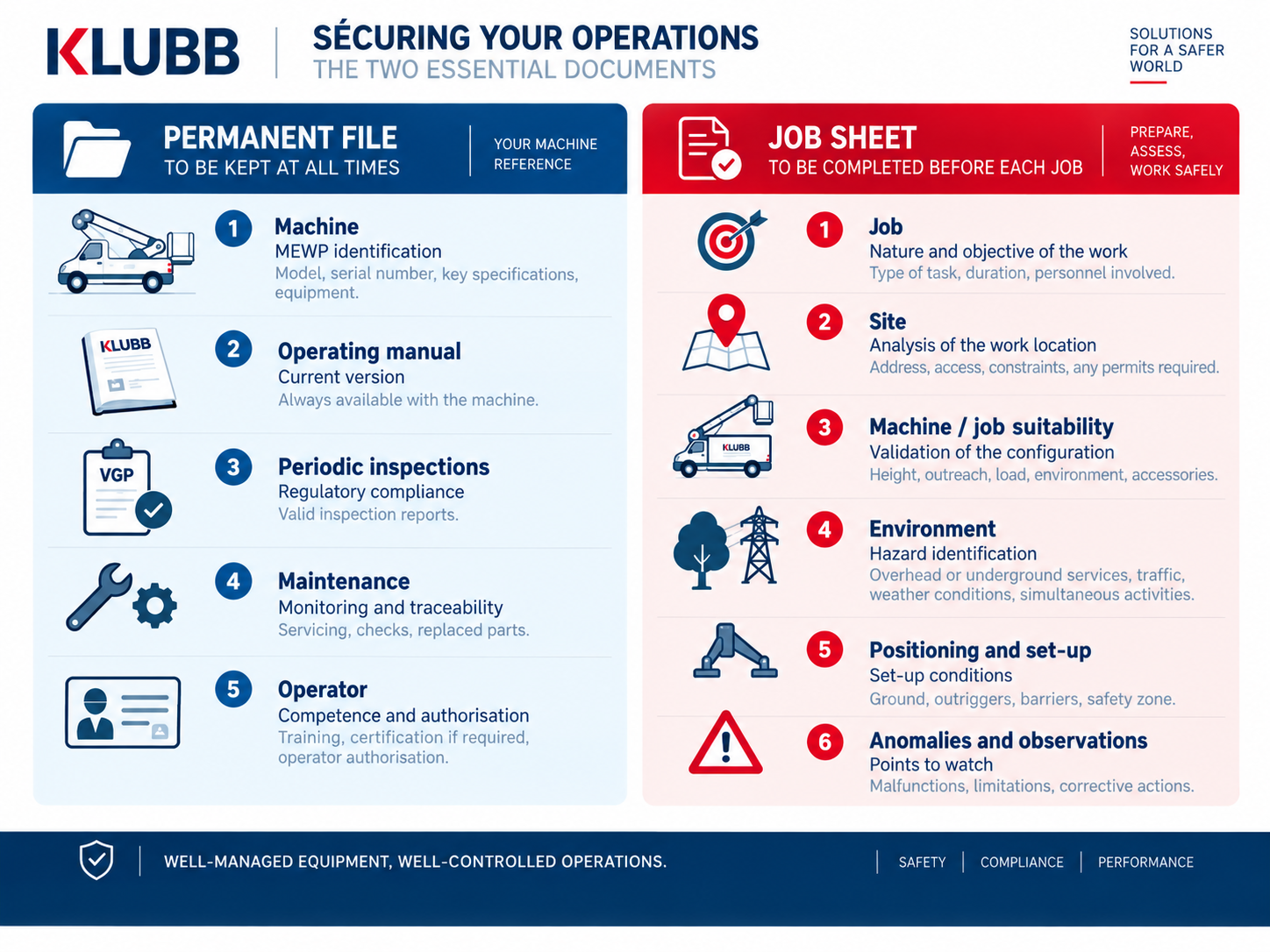
It therefore makes sense to distinguish between a permanent machine file and a job-specific record. This keeps relatively stable information in one place, while ensuring that matters requiring reassessment are considered afresh for each site and task.
The permanent file stays with the machine
The permanent file should give ready access to the MEWP's identification details, operator's manual, evidence of the most recent inspection required in the country of operation, and records of servicing, repairs and maintenance.
The operator's manual remains the primary reference for the machine itself. ISO 18893:2024 covers principles for MEWP selection, inspection, maintenance and safe operation. IPAF's guidance on machine-specific familiarisation likewise emphasises reviewing the manufacturer's instructions, operating limits, safety systems, evidence of inspection and emergency controls before taking charge of an unfamiliar MEWP.
Within the EU, Article 5 of Directive 2009/104/EC provides for inspections by competent persons where applicable, including periodic and special inspections under the circumstances it describes. It does not prescribe a single six-month interval for all MEWPs across Europe: detailed examination regimes and frequencies are determined under national rules and the circumstances of use. Beyond the EU, the applicable local requirements and the manufacturer's instructions must be established before the machine is deployed.
The operator's training and competence must also be verifiable. Article 9 of Directive 2009/104/EC addresses adequate training for those entrusted with using work equipment that entails a specific risk. ISO 18878:2025 provides an international framework for the content and administration of MEWP operator training; national or other requirements may be more stringent.
Training in a MEWP category does not remove the need for familiarisation with the actual model. IPAF's F1 guidance covers matters such as the controls, warning devices, operating limitations, pre-use checks and emergency lowering procedures. Operators and nominated ground rescue personnel need the familiarisation appropriate to their duties.
Evidence of training, assessment and permission to operate should be treated as distinct matters. An IPAF PAL Card or another recognised training credential may help demonstrate completed training, but it is not a universal substitute for employer authorisation, any required site permission or the competence checks mandated by local law. Medical fitness requirements, where applicable, are likewise jurisdiction-specific rather than governed by one worldwide MEWP rule.
The job sheet captures what changes
The job sheet serves a different purpose. It relates to a specific assignment and records variable factors: the nature of the work, location, MEWP selected, site constraints, set-up conditions and any defects or irregularities identified.
|
GUIDING QUESTION What is different today, and how could it affect the way you operate the machine? |
This distinction avoids two opposite pitfalls: duplicating familiar information every day, or relying on a procedure so generic that it no longer reflects what is actually happening on site.
|
KEY POINT — ELECTROMAGNETIC COMPATIBILITY MEWP compliance also covers the behaviour of electronic systems within their electromagnetic environment. European legislation governs their ability to operate without unacceptable electromagnetic interference and to limit emissions that could affect nearby equipment. See European Directive 2014/30/EU on electromagnetic compatibility. KLUBB states that it conducted an electromagnetic compatibility (EMC) test programme on its vehicle-mounted MEWPs in conjunction with the Emitech Group, assessing, in particular, the immunity of electronic control and safety systems and the interference they may generate. These tests concern equipment conformity. They are no substitute for a site assessment, pre-use checks or the rules governing the operation itself. |
Periodic inspection, task suitability and pre-use checks: three different questions
An up-to-date periodic inspection can provide evidence of the machine's condition at the time it was examined. It does not, in itself, establish whether that MEWP is suitable for the job you are about to undertake.
This distinction matters because three separate decisions underpin safe MEWP use: the equipment's inspection and maintenance status; its suitability for the task and site, established through planning and risk assessment; and the pre-use checks and reassessment immediately before work. They complement one another, but each serves a different purpose.
The periodic inspection addresses the condition of the equipment
Periodic inspections address deterioration, safety-critical condition and any other matters within the applicable examination regime. In the EU, Article 5 of Directive 2009/104/EC addresses periodic and special inspections for relevant work equipment, carried out by competent persons. ISO 18893:2024 establishes broader international principles for inspection and maintenance.
Inspection intervals are not uniform worldwide, nor is there a single EU-wide six-month rule for MEWPs. Your procedure must identify the frequency, competent-person arrangements and evidence required by national legislation, applicable standards and the manufacturer's instructions. It must also take account of any restrictions or outstanding defects recorded during inspection.
It therefore provides information about the machine itself. It does not tell you whether the carrier vehicle can be positioned close enough to the work area, whether the available outreach will be sufficient or whether the proposed outrigger positions are compatible with the ground conditions.
The suitability assessment considers the machine in relation to the task
A suitability assessment asks whether the selected MEWP can perform the intended task in the conditions actually anticipated. In the EU, Directive 2009/104/EC requires employers to take account of workplace conditions and the hazards associated with the use of work equipment. ISO 18893:2024 and IPAF's 'Back to Basics' guidance reinforce the need to select an appropriate MEWP within a documented safe system of work.
For a vehicle-mounted MEWP that moves between successive sites, that assessment cannot simply be copied from the previous job. Access routes, working height, outreach, platform load, ground conditions, neighbouring activities and the means of rescue must be reviewed for the location concerned. The detail and formal status of the assessment should reflect local legal requirements.
Pre-use checks test the plan against conditions on the ground
Before each operation, the team needs to confirm that the MEWP still matches the intended work and that actual site conditions accord with the plan. IPAF's safe-use guidance specifically highlights working height, outreach, rated platform load, ground support, traffic and access as factors affecting selection and use.
This final check does not replace either the documented task risk assessment or the machine's periodic inspection. It is the last opportunity to identify a discrepancy between what was planned, the state of the equipment and the conditions found on site.
|
KEY POINT Periodic inspection: what is the machine's examination and maintenance status? Suitability assessment: is this machine appropriate for the task and site? Pre-use checks: do actual conditions and the machine's condition allow work to proceed? |
Look beyond working height: positioning often determines what is achievable
Working height remains an important selection criterion. On its own, however, it cannot establish whether a MEWP is suitable for a particular job.
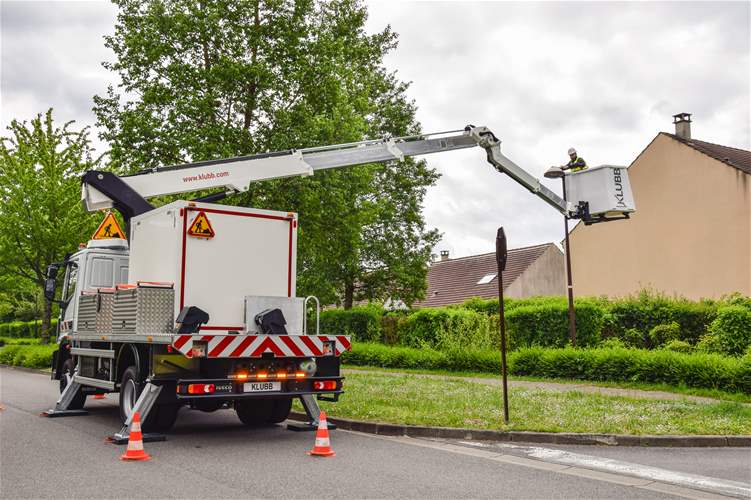
Two street-lighting columns of similar height can require markedly different operating configurations. If you can position the carrier close to the first, very little outreach may be needed. If the second stands behind a fence, hedge or immovable obstruction, several additional metres of reach may be essential.
IPAF's international guidance on selecting MEWPs for work in public areas identifies working height, outreach, rated load, wind and site access among the relevant criteria. The XTENSO 3 manual adopts the same practical approach: it calls for the truck's position to be assessed in relation to the ground, surrounding traffic, obstacles, access routes and the work position to be reached.
Your job pack should therefore require the machine's nominal performance to be assessed against its actual operating configuration. Sufficient working height does not guarantee that the carrier can be positioned to make use of the required section of the working envelope.
Treat ground conditions as a fundamental part of setting up
A road or car park may appear level without necessarily having sufficient bearing capacity to withstand the loads transmitted by the machine.
IPAF's guidance on ground conditions stresses the need to establish whether the surface and any underlying structures can sustain the loads imposed by the MEWP. A paved area may conceal voids, drains, service ducts, cellars or other structures whose bearing capacity is uncertain; differential settlement and localised failure also need to be considered.
IPAF's guidance on safe use in public areas recommends assessing ground-bearing capacity and, where appropriate, using suitably sized spreader pads to reduce contact pressure beneath outriggers. The machine-specific load information and the manufacturer's set-up instructions must govern the final arrangement.
For the XTENSO 3, KLUBB requires a stable surface to prevent the outriggers from sinking. Its manual specifies the use of load-spreading pads where necessary, requires each outrigger foot to rest flat and prohibits stabilisation on the edge of a kerb because of the risk of slipping. It also highlights the hazards posed by manhole covers.
On a vehicle-mounted MEWP, the carrier itself must also be checked
In the XTENSO 3 configurations described by KLUBB, the carrier's wheels contribute to the machine's stability. The manual therefore requires checks of tyre condition and pressure, and specifies several configurations in which the wheels must remain in contact with the ground.
Manufacturer's source: KLUBB XTENSO 3 Operator's Manual, sections 3.16 and 6.2, 10/2022 edition.
The objective is not to turn a MEWP job pack into a geotechnical survey. It is, however, to look beyond the apparent condition of the surface and establish precisely where each outrigger will bear — and what lies beneath it.
|
“Ground that looks level is not necessarily suitable for supporting the machine. On site, you need to assess not just where each outrigger will rest, but also what may lie beneath the surface.” |
Assess the entire operating area
Vehicle positioning cannot be considered in isolation from the space through which the boom will travel.
A façade feature, branch, sign, overhead line or other obstruction may alter the intended boom path. At ground level, the movement of vehicles, pedestrians, cyclists and other plant must also be accounted for in the site arrangements.
IPAF's guidance on MEWPs in public areas addresses interactions with moving traffic, pedestrians, overhead obstructions and the use of suitable exclusion zones. The XTENSO 3 manual likewise requires the operator to check that nobody is within the MEWP's operating radius and to prevent contact with fixed or moving obstacles.
Use the checklist alongside the manual, never in place of it
Pre-use inspection is another essential preparation stage. ISO 18893:2024 addresses MEWP inspection and safe operation, while IPAF's familiarisation guidance includes visual inspections, pre-use checks and safety-system checks as matters operators must understand for the particular machine. These checks are distinct from inspections performed at statutory or planned intervals.
In practice, pre-use checks should cover the machine's visible condition, its points of support and the protective functions that can safely be checked in accordance with the operator's manual. The checks must reflect the machine's design, any reported defects and the conditions in which it will be used.
Nevertheless, a generic checklist has obvious limitations.
What needs to be checked depends on the model, its design and the manufacturer's instructions. For the XTENSO 3, KLUBB specifies checks covering the carrier vehicle, tyres, potential leaks, outriggers and certain structural components. The manual also calls for a no-load test of the machine's movements.
The job pack can therefore identify the main categories of checks, but it should not attempt to reproduce a supposedly universal list. Whenever an inspection depends on the particular model or its configuration, the relevant MEWP operator's manual remains authoritative.
Make weather conditions part of the decision
Weather must form part of the site assessment and the decision to commence work. IPAF's guidance on safe MEWP use identifies wind and adverse conditions as operational hazards; the operator must also account for sudden gusts, storms and localised effects caused by surrounding structures.
The applicable wind-speed limit is the one specified by the manufacturer for the MEWP and its configuration. Between buildings, wind can accelerate or become turbulent, so a measurement taken in a sheltered position may not reflect conditions at platform height. Never substitute a generic rule of thumb for the machine's stated limitations.
The relevant limit is therefore the one specified for the particular machine and operating configuration. Applying a single generic wind-speed threshold across several models could instead lead to confusion.
The XTENSO 3 manual sets out its own limits, including by reference to the manufacturer's data plate. It also prohibits operation during thunderstorms.
|
KEY POINT A box marked ‘weather checked’ is not enough. Your procedure must allow you to compare actual conditions with the operating limits specified for the MEWP being used. |
Be prepared for set-up to challenge your original assessment
Any assessment carried out before arrival can only be based on the information available at the time. Setting up the MEWP is the point at which those assumptions meet the actual site conditions.
A difference of just a few tens of centimetres may change the situation. An outrigger expected to rest on a uniform stretch of carriageway may end up next to an inspection chamber. A small adjustment to the vehicle's position may encroach further onto the road or change the boom path needed to reach the work area.
Where the XTENSO 3 is identified as a Group B, Type 1 MEWP (commonly described as '1B'), the team must give particular attention to the intended stationary operating position, outrigger deployment, exclusion zones and levelling. These are consistent with the practical safe-use and set-up principles addressed by ISO 18893:2024 and IPAF guidance; KLUBB's model-specific instructions remain decisive.
For this model, the manufacturer requires, among other things, the vehicle to be immobilised, outrigger deployment paths to remain clear, suitable support beneath the outriggers and a check that the machine is level once they have been deployed.
Your job pack must therefore allow the initial assessment to be revisited. Sound preparation is not a plan to be followed at all costs; it is a process that enables you to recognise promptly when an earlier assumption no longer holds true on site.
|
“The best position is not necessarily the one that puts the vehicle closest to the work. You need somewhere that allows you both to reach the task and to set up the machine correctly.” |
Plan emergency recovery before anyone goes up
Planning a job is not solely about how the operator will reach the work area. It must also establish how that person can be brought safely back to ground level should the normal controls become unavailable.
IPAF's guidance on MEWP recovery and rescue emphasises a site-specific plan, identified responsibilities and personnel who are familiar with the machine's ground and emergency controls. The ground rescue position must remain accessible, and the arrangements must account for communication, supervision and the possibility that the operator cannot operate the platform controls.
The XTENSO 3 manual makes a particularly important point: the basket is not necessarily visible from the ground control station in every operating position. KLUBB therefore recommends, wherever possible, undertaking emergency recovery within an area visible from those controls.
The manual further specifies that emergency mode is reserved for movements needed to stow or recover the platform and must be operated cautiously at reduced speed.
Simply recording that the 'emergency procedure is known' is therefore insufficient. Before elevation begins, the team must know who can operate the machine from the ground, where the emergency controls are located, whether they will remain accessible after set-up and how communication with the basket will be maintained.
Allow for circumstances in which work must be suspended
A checklist must never become a mechanism that implicitly pressures a team to tick a succession of positive answers merely so that work can continue.
A defect or unexpected condition may mean repositioning the vehicle, changing site arrangements, selecting another machine or commissioning a further assessment.
ISO 18893:2024 addresses safe MEWP operation, inspection and maintenance, while IPAF's safe-use guidance emphasises reporting defects and preventing unsafe equipment from being used. A defect affecting safety must trigger the machine-specific action required by the manufacturer and any additional withdrawal-from-service, reporting or examination duties imposed locally.
|
KEY POINT Alongside ‘compliant’ and ‘non-compliant’, your job pack can usefully allow a third response: WORK SUSPENDED — further assessment or a decision is required. This makes it possible to record a situation requiring judgement, rather than reducing the decision to a simple green or red box. |
Keep records that serve a clear purpose
Record-keeping helps teams track an operation, investigate a defect and understand why a particular decision was taken. It becomes counterproductive, however, when information is retained routinely without a defined purpose.
Neither the EU work-equipment provisions discussed here nor the cited ISO and IPAF guidance establish a blanket international rule requiring time-stamped photographs of every MEWP set-up or individual outrigger. Site rules, contractual procedures or national legislation may call for additional evidence; the job pack should identify what is actually required and why.
A photograph can nevertheless be valuable when documenting an unusual configuration, providing context for a defect or recording the circumstances behind a particular decision.
Some information already has its own dedicated record. The XTENSO 3 manual includes an inspection log intended to accompany the MEWP throughout its service life. It provides for recording matters relating to servicing, repairs, maintenance and the replacement of components and safety devices. The manual also refers to a job sheet that must be completed and signed.
A well-structured job pack therefore distinguishes between legally required inspection and safety records, manufacturer documentation and internal site-specific evidence. Under Article 5 of Directive 2009/104/EC, inspection results must be recorded and retained, with evidence of the latest inspection accompanying work equipment used outside the undertaking. Other records should be retained when they support a defined operational or legal purpose.
|
“Records should make clear what was checked and what was found. If a piece of information cannot be linked to a particular machine, site or defect, its practical value is limited.” |
What should your MEWP job pack look like?
To remain practical, the document completed on site must be concise. The permanent machine file can travel with the MEWP or be accessible digitally. With properly targeted questions, the site-specific section may occupy no more than one or two pages.
|
Section |
What your job pack should establish |
Possible record |
|
Job details |
Location, task, area to be reached |
Work order / site sheet |
|
MEWP and operator |
Machine identified, documentation accessible, competence and permission to operate confirmed |
Inspection and training records |
|
Suitability |
Working height, outreach, load, access, site constraints |
Suitability assessment |
|
Environment |
Ground, obstructions, traffic, utilities, weather, other activities |
Observations and measures taken |
|
Pre-use checks |
Machine condition and checks prescribed by the manual |
Inspection sign-off |
|
Set-up |
Position, barriers, outriggers, levelling |
On-site confirmation |
|
Emergency recovery |
Person on the ground, access to ground controls, applicable procedure |
Identification / confirmation |
|
End of job |
Defects, possible withdrawal from service, handover |
Report / log, where required |
This structure brings together the themes reflected in Directive 2009/104/EC, ISO 18893:2024 and IPAF guidance: appropriate selection, operator competence, inspections, assessment of the site, pre-use checks, safe set-up, emergency recovery and reporting at the end of the job.
An effective procedure should support sound decisions
The quality of a MEWP job pack is not measured by the number of boxes it contains or the volume of paperwork it generates.
Its value lies in helping you reconcile four considerations: the task to be completed, the MEWP's capabilities, the manufacturer's instructions and the conditions actually encountered on site.
International MEWP good practice does not reduce pre-use checks to a purely mechanical inspection. ISO 18893:2024 and IPAF guidance address the wider operating context: documentation, equipment condition, weather, task suitability, surrounding hazards, exclusion zones, set-up and recovery planning. The manufacturer's manual then supplies the model-specific requirements governing checks, operating limits, stabilisation, safety systems and emergency procedures.
Before deploying the boom, your procedure should help you answer several questions clearly. Can the selected MEWP carry out the intended work? Can the carrier be properly positioned and stabilised? Will the ground safely support the proposed outrigger positions? Are the prevailing conditions within the machine's operating limits? And if circumstances deteriorate, do the site arrangements genuinely allow an effective intervention from the ground?
A well-designed job pack should make these decisions easier, not harder. It should help you make them promptly and recognise when changing conditions mean that work must be adapted, postponed or suspended.
|
“A good procedure should not make a job more complicated. Above all, it should help you take a few minutes to check the factors that could genuinely change how you work.” |