






Yes, a workshop body reduces the available payload by adding its own weight to the vehicle. However, if you operate a truck-mounted access platform on a daily basis, this observation alone does not tell the whole story.
What really matters is how much payload remains once the truck, access platform, workshop body, fittings, operators and equipment are all accounted for in the configuration that leaves your depot.
The answer depends on two limits: the vehicle's maximum authorised mass (MAM) and the maximum permissible axle loads. The Xtenso operator's manual also requires drivers to check the total weight and distribution of the equipment carried to prevent axle overloading.
This is far more useful than simply knowing the workshop body's storage volume: available storage space does not necessarily mean available payload capacity.
How Much Equipment Can You Actually Carry?
To find out, you need to consider the complete vehicle, fully equipped and ready for work.
The weight of the bare chassis or a theoretical figure from a product specification is not enough. Your truck operates with its access platform, subframe, workshop body, permanently installed equipment, fluids, crew and everything required for the job.
Theoretical remaining payload = MAM − actual weight of the vehicle ready for work
The Vehicle's MAM Sets the First Limit
When travelling on public roads, the vehicle's actual weight must not exceed the maximum authorised mass specified in its registration documents.
Under French road traffic regulations, the actual load carried by an individual axle must also remain within its maximum permitted limit.
You therefore need to check the vehicle's overall weight before examining the load carried by each axle separately.
A large workshop body may offer enough space to accommodate several hundred kilograms of equipment without the vehicle having the legal capacity to carry it.
Conversely, a well-organised workshop body can provide sufficient equipment for an entire working day while keeping the load under control. The determining factor is weight, not the number of shelves available.
Weigh Your Truck in a Configuration That Reflects a Typical Working Day
To obtain meaningful figures, the weighing process must include everything normally carried by the vehicle:
- The truck chassis, access platform, subframe, outriggers and workshop body.
- Permanently installed fittings, including cabinets, shelves, drawers, workbenches and storage compartments.
- Fuel, AdBlue and other operating fluids.
- The driver and any additional passengers.
- Personal protective equipment (PPE), traffic management equipment, outrigger spreader pads and wheel chocks.
- Permanently carried tools, batteries, spare parts and consumables.
This approach provides a realistic assessment of the payloadremaining under normal operating conditions.
It also allows you to compare vehicles across your fleet on a consistent basis, rather than relying on theoretical specifications that no longer reflect the weight of the fully equipped truck.
Staying Within the MAM Is Not Enough: Weight Distribution Matters Just as Much
Two trucks with exactly the same gross weight can place very different loads on their axles. Heavy equipment stored near the cab, between the axles or behind the rear axle will affect weight distribution differently.
The Xtenso operator's manual is explicit on this point: drivers must check that equipment is properly secured and verify both its total weight and distribution to prevent axle overloading.
The position of your storage compartments is therefore a technical consideration in the body design, rather than merely a matter of convenience or accessibility.
The final figure is particularly valuable for operators and fleet managers.
It indicates how much additional equipment the vehicle can actually carry, taking into account both the margin below its MAM and the load already supported by each axle.
Does a Workshop Body Reduce the Access Platform's Performance?
Not necessarily.
It is important to distinguish between the truck's payload capacity and the performance of the access platform itself.
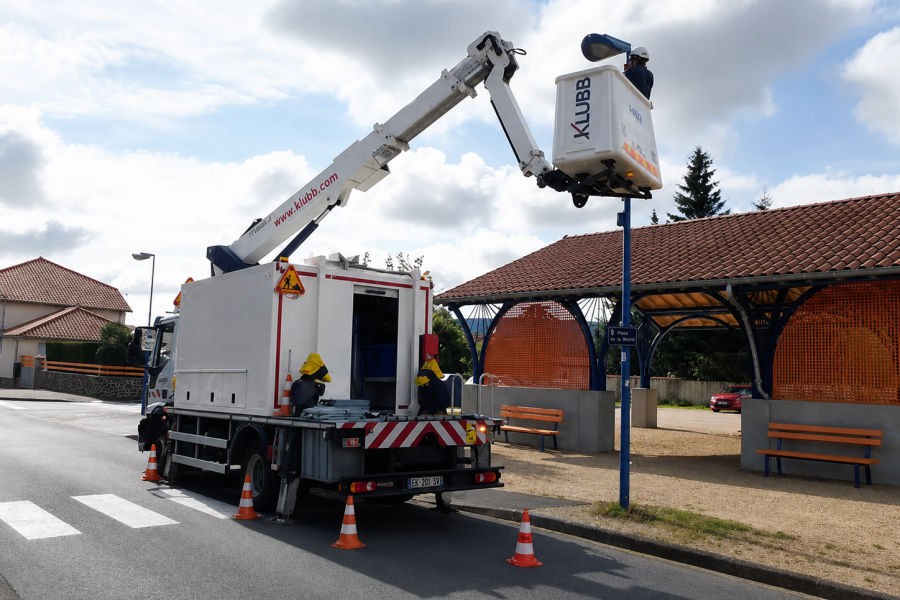
In KLUBB's technical documentation, the Workshop Body and Flatbed versions are identified as specific machine configurations, each with its own general arrangement drawings and working envelope diagrams.
The workshop body is therefore not treated as an improvised addition fitted to the vehicle after production.
The Xtenso Workshop technical specifications provide the following figures:
| Specification | Xtenso 3 Workshop | Xtenso 4 Workshop |
|---|---|---|
| Working height | 18.5 m | 21 m |
| Maximum outreach | 13.9 m | 16.5 m |
| Basket capacity | 265 kg | 265 kg |
| Turret rotation | 420° | 420° |
Important: the 265 kg figure refers to the basket's rated load capacity, not the weight of equipment that can be stored inside the workshop body.
The operator's manual specifies that the platform's rated capacity includes the weight of the operators and the tools used for the intended work.
These two capacities must therefore be considered separately when calculating permissible loads.
Storage Volume Does Not Equal Payload Capacity
This is probably one of the most common mistakes when preparing a workshop-equipped truck.
A workshop body may still have plenty of available storage space even when the remaining payload is already limited.
Cable drums, batteries, lighting equipment, metal components and power tools can quickly add tens or even hundreds of kilograms without filling the available storage volume.
It therefore makes sense to distinguish between equipment carried permanently and equipment required for a particular job.
PPE, traffic management equipment and everyday tools can remain on board. Spare parts, consumables and specialist equipment can then be loaded according to the work scheduled for each day.
This approach prevents your team from carrying stock that is only occasionally needed.
How Can You Design a Workshop Body Without Unnecessarily Reducing the Available Payload?
The process begins before any equipment is loaded.
Every permanently installed cabinet, drawer, shelf or workbench adds weight to the vehicle.
The more elaborate the interior fittings, the greater the proportion of the payload consumed before you have even stored your first tool.
The right balance depends on the work you carry out.
A street lighting team, a telecommunications technician and a utility network maintenance crew do not need to carry the same components or quantities of equipment.
The most suitable workshop body is not necessarily the one offering the greatest amount of storage, but the one that meets your operational requirements while keeping weight and its distribution under control.
Why Accept the Additional Weight?
Because the performance of a truck-mounted access platform cannot be measured solely by its remaining payload.
If the workshop body allows your team to carry the tools, equipment and spare parts needed for several jobs, it can reduce return journeys to the depot and, depending on the work involved, eliminate the need for a separate support vehicle.
The key question then becomes: how much operational autonomy do you gain from the weight you carry?
A properly specified workshop body uses part of the truck's payload capacity. However, that additional weight can deliver genuine operational benefits when it corresponds to the equipment your team actually needs throughout the working day.
So, Does a Workshop Body Compromise Performance?
A workshop body inevitably reduces the truck's available payload.
However, it does not automatically mean a reduction in working height, outreach or basket capacity when the machine has been designed for this configuration.
For the Xtenso Workshop models, KLUBB's technical documentation clearly distinguishes the Workshop Body configuration and specifies the corresponding aerial performance of the complete machine.
For operators, the real limitation lies in the weight of the truck when fully prepared for work and how that weight is distributed between the axles.
Before focusing on how much equipment you can fit inside the workshop body, establish how much payload remains available.
That is the figure that allows you to answer the question that matters most in everyday operations:
"Once my truck is fully equipped and ready to leave, how much additional equipment can I still carry?"