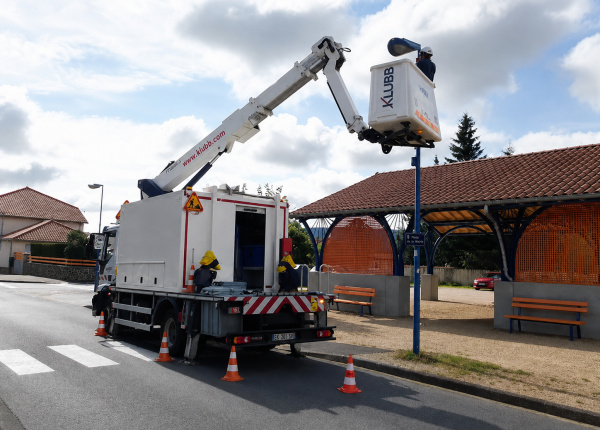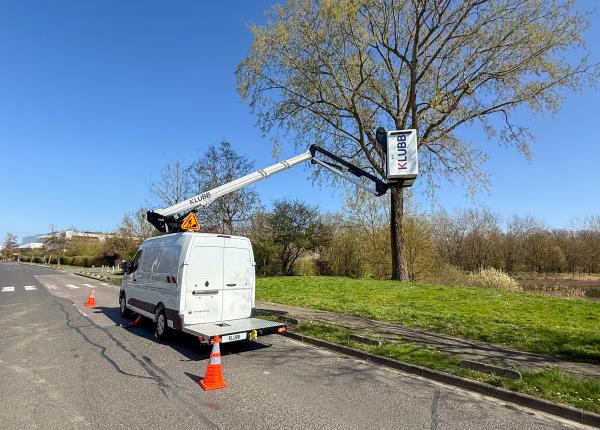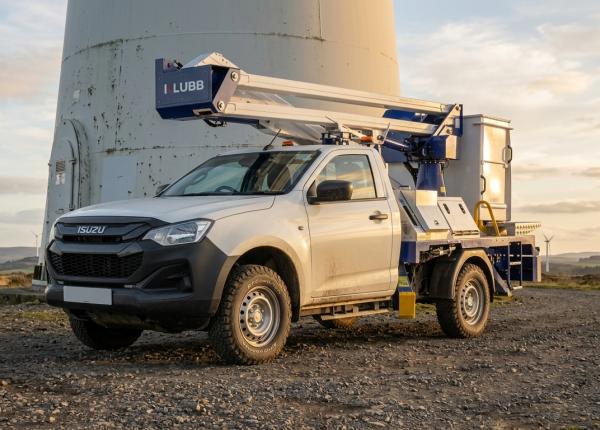







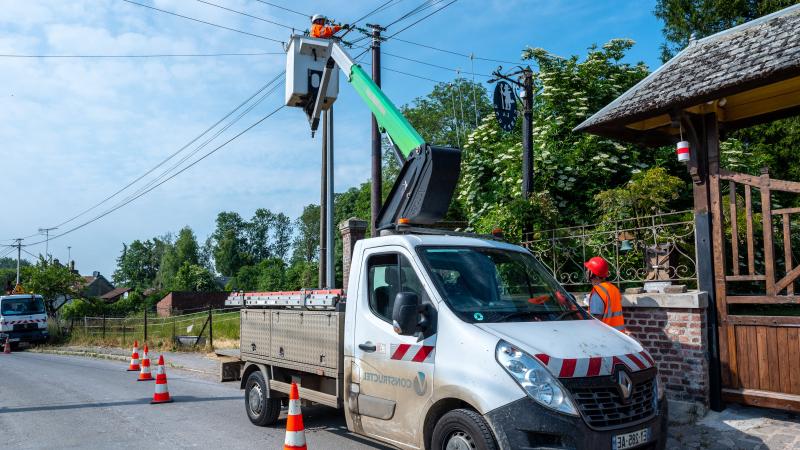
When using a mobile elevating work platform (MEWP) to install telecommunications cables, maintain street lighting or work on overhead power lines, you may face several hazards at the same time.
Electrical hazards are among the most serious, but they are far from the only concern. Falls from height, passing traffic and falling objects can all put your safety at risk. Keeping your worksite safe depends as much on preparation, equipment selection and team coordination as it does on the MEWP itself.
Network Technicians Work in a Wide Range of Environments
The role of a utility network technician covers a broad range of activities. You may be involved in installing, maintaining or commissioning low- and high-voltage electrical networks, whether overhead or underground.
Your responsibilities may also extend to copper and fibre-optic telecommunications networks, alongside various types of urban infrastructure, including:
- Street lighting
- Traffic signs and signals
- Electric vehicle charging points
- CCTV and video surveillance systems
This variety of work exposes you to very different operating conditions. One day, you may be working in a narrow residential street; the next, alongside a busy road, in a rural area or near overhead power lines.
Each location requires a fresh assessment of its surroundings.
You cannot simply repeat the working procedure used on the previous job. Network configurations, traffic conditions, weather, overhead obstructions, ground bearing capacity and the space available around your truck-mounted MEWP may all have changed.
What Are the Main Risks Facing Utility Network Technicians?
Accidents often result from several contributing factors rather than a single mistake.
An incorrectly identified network, poorly positioned vehicle, inadequate traffic management or unexpected boom movement can combine to create a dangerous situation.
Your risk assessment should therefore cover the entire operation, from arrival on site to the complete stowing of the MEWP and removal of the worksite equipment.
Electrical Hazards
When working near electrical infrastructure, the most serious risks include electric shock, electrocution, burns and arc flash.
An incident does not necessarily require direct contact with an energised conductor. Electrical arcing or flashover may occur when equipment approaches a live power line too closely.
The danger is not limited to the person in the basket. The MEWP boom, tools, cables being handled or other equipment may enter a hazardous area. You must also consider conductor movement caused by wind and any movement or swinging of the equipment in use.
The International Powered Access Federation (IPAF) guidance on working near power lines emphasises the importance of identifying electrical hazards, establishing exclusion zones and consulting the relevant electricity network operator before work begins.
There is no single minimum approach distance that can be applied universally to every country, voltage and type of operation.
The required clearance depends on the applicable national regulations, network characteristics and precautions specified by the electricity network operator. These distances must be established during planning and maintained throughout the operation.
You must also distinguish between working near energised electrical infrastructure and carrying out live electrical work. The latter requires specific procedures, competencies and equipment under the regulations applicable to the work.
An insulated MEWP does not, by itself, authorise an operator to carry out live electrical work.
Falls from Height and the Risk of Ejection
Working on poles, building façades, overhead lines and urban infrastructure frequently requires access to elevated positions.
A truck-mounted or van-mounted MEWP provides access through a basket fitted with guardrails, offering collective protection against falls.
However, guardrails do not eliminate the risk of an occupant being thrown from the platform following an impact, sudden boom movement or incorrect operation.
IPAF describes this phenomenon as the MEWP catapult effect.
For example, if a passing vehicle strikes the boom of your MEWP, the impact may transmit a sudden movement through the structure, potentially throwing you out of the basket.
This risk can be underestimated precisely because the platform is surrounded by guardrails.
For boom-type MEWPs, IPAF recommends that occupants wear a full-body harness with an adjustable restraint lanyard, kept as short as practicable and attached to the manufacturer's designated anchorage point.
The equipment must be appropriate for the task, the MEWP and the applicable safety requirements.
Risks Associated with Road Traffic
Utility network maintenance frequently takes place on pavements, verges or directly on the carriageway.
In these situations, your vehicle may occupy part of a traffic lane while the boom and basket operate above or close to other road users.
Before beginning work on or near a public road, you must establish an appropriate traffic management arrangement. The aim is to make the worksite visible in sufficient time for approaching road users to recognise the hazard and respond safely.
Depending on the road layout, traffic speed and extent of the working area, this may include:
- Advance warning signs
- Temporary road signs
- Traffic cones
- Physical barriers
- Warning lights
- Additional vehicle-mounted warning equipment
The IPAF guidance on the safe use of MEWPs in public areas addresses the risks associated with operating access platforms where pedestrians and moving vehicles may be present.
Where possible, position your MEWP to minimise the boom's exposure to passing traffic.
If this cannot be achieved, additional measures may be needed to physically separate the working area from traffic or temporarily alter traffic movements. All arrangements must comply with local road traffic management requirements.
Falling Tools and Materials
When working above ground level, anyone below your basket — including colleagues, pedestrians and other contractors — may be exposed to falling tools, cables, components or dismantled equipment.
Wearing a safety helmet is not, on its own, sufficient protection against falling objects.
An effective approach is to establish an exclusion zone beneath and around the elevated working area.
Its boundaries should take account of the working height, the type of materials being handled and the possibility of objects bouncing or being deflected after impact.
Tools and materials should also be secured or otherwise controlled where necessary to prevent them from falling.
Manual Handling and Physical Strain
Network installation and maintenance often involve carrying tools, cables, connection equipment and awkward or bulky components.
Repeated handling, restricted working positions and reaching beyond a comfortable distance can increase the risk of musculoskeletal injuries and falls.
The vehicle's configuration and storage layout can help reduce unnecessary movements by keeping equipment organised and accessible.
Your choice of MEWP matters just as much.
The most suitable platform is one that allows you to position the basket close to the work area without excessive reaching or leaning beyond the guardrails.
How Should You Prepare for Work on Utility Networks?
Identify the Networks Present
Before starting work, establish the type, location and characteristics of the networks in the area.
This means identifying both the infrastructure you intend to work on and any neighbouring services that could create additional hazards.
Procedures for obtaining network information differ between countries, but the underlying principle remains the same: consult the relevant utility owners and obtain reliable information about the infrastructure before beginning work.
Depending on the location and nature of the activity, this may involve reviewing utility drawings, consulting network operators, submitting statutory notifications or arranging a site survey.
In the United Kingdom, for example, the Health and Safety Executive's HSG47 guidance on avoiding danger from underground services identifies three essential elements: planning the work, locating and identifying buried services, and adopting safe working methods.
Such information must be incorporated into your site-specific risk assessment and communicated to everyone involved.
This is particularly important when installing telecommunications infrastructure near electrical distribution networks.
The absence of visible electrical equipment does not guarantee that no electrical hazard is present.
Assess Your Surroundings Before Setting Up
A site survey allows you to check whether the information gathered during planning accurately reflects the conditions you encounter.
The assessment must cover the entire space in which your vehicle, boom and basket will operate.
Pay particular attention to:
- The location, height and characteristics of overhead services
- Road width and traffic density
- Pedestrians, cyclists and access to neighbouring properties
- Ground slope, level and bearing capacity
- Trees, buildings, façades and other obstructions
- The space required for boom deployment and movement
- Traffic management and worksite segregation arrangements
- Access to ground controls and emergency lowering systems
Ground conditions deserve particular attention.
Never set up or operate a MEWP on ground that cannot safely support the vehicle, its outriggers and the loads imposed during operation.
Always remain within the limits specified in the manufacturer's operating instructions.
The international standard ISO 18893:2024 provides a framework for the safe selection, inspection, maintenance and operation of mobile elevating work platforms.
Establish a Safe System of Work
Your vehicle's position must account for the complete path of the boom and the basket's location throughout the operation.
Assessing only the initial distance between the vehicle and a nearby power line or obstacle is a serious mistake.
Your safe system of work should define who operates the MEWP, who supervises the site, how team members communicate and which procedures must be followed in an emergency.
A nominated ground rescue person must be familiar with the machine's emergency lowering procedures and able to access the relevant controls when required.
This person should also be able to alert the operator if a vehicle, pedestrian or other hazard enters the working area.
IPAF's Principles of MEWP Recovery and Rescue recommend a documented rescue plan specific to the task, the machine and the worksite.
How Can You Secure Your Worksite Before Raising the Basket?
Once your vehicle is positioned, several checks must be completed before anyone is elevated.
These preparations are essential to maintaining the machine's stability and protecting operators, colleagues and members of the public.
Establish Your Worksite Exclusion Zone
Install the required traffic management equipment and safety barriers before work begins.
The objective is not merely to warn people that work is taking place, but to give them sufficient time and space to avoid the hazard.
Your exclusion zone must account for the entire operating envelope of the MEWP, including areas beneath the boom and basket and any positions they may occupy during the work.
Where a person is assigned to monitor passing traffic, their presence should not be treated as an infallible protective measure.
Depending on the level of exposure, physical barriers, additional warning equipment or temporary traffic restrictions may still be necessary.
In European workplaces, Directive 92/58/EEC establishes minimum requirements for workplace safety and health signs. However, public road traffic signs remain subject to the applicable road traffic regulations.
Inspect Your MEWP and Vehicle
Before entering the basket, carry out the pre-use checks specified by the manufacturer and your company's operating procedures.
The overall condition of the vehicle, boom, basket, controls and safety devices must form part of this inspection.
Pay particular attention to:
- Platform and ground controls
- Emergency stop devices
- Stabilisation systems and outriggers
- Tyres and ground contact points
- Basket guardrails and access gate
- Alarms and warning systems
- Manufacturer-approved anchorage points
- Visible hydraulic leaks, damage or deterioration
Never disregard a defect.
If a fault could compromise stability, control functions or safety systems, remove the equipment from service until it has been assessed and made safe by a competent person.
The European Directive 2009/104/EC establishes minimum safety and health requirements for the use of work equipment by workers.
At international level, ISO 18893:2024 also addresses inspection, maintenance and safe operation, providing a common technical reference alongside applicable national regulations.
Stay Within Your MEWP's Operating Limits
Working height and outreach are not the only limitations you need to consider.
The basket's rated load capacity, maximum number of occupants, permitted wind speed, ground inclination and outrigger configuration can all determine whether an operation can be carried out safely.
Remember to include the weight of your tools, materials and any equipment carried in the basket when calculating the total platform load.
Never use a ladder or stepladder inside the basket to gain additional working height.
The platform must be operated within the working envelope and limitations defined by its manufacturer.
Prepare Before You Work at Height
Safe working at height relies on a series of decisions made before and during the operation.
Your MEWP provides access to elevated utility infrastructure while offering a protected working platform. But its effectiveness depends on selecting the appropriate machine, inspecting it correctly and ensuring that everyone involved understands how it must be operated.
Site assessment, electrical hazard identification, traffic management and emergency preparedness should never be treated as separate considerations. Together, they form the foundation of a safe working operation.
International guidance such as ISO 18893:2024 and ISO 18878:2025 on MEWP operator training supports a consistent approach to equipment selection, operator competence and safe use across different markets.
KLUBB offers a range of truck-mounted and van-mounted access platforms designed for professionals working in electrical utilities, telecommunications and street lighting.
Our teams can help you select a vehicle configuration suited to your access requirements, working environment and the technical demands of your operations.