





In a previous guide, we set out the main criteria to consider when choosing the right van-mounted platform. We also stressed one essential point. Your decision-making process should not begin with the technical data sheet. It should begin with your trade, your operating environment and the practical constraints your teams encounter on site.
Once this operational map has been established, the choice of working height and outreach becomes much more coherent, and above all far more relevant. These two criteria remain decisive, as they determine how high the basket can rise and how far from the vehicle the operator can reach.
In this guide, we would like to take the discussion a step further by addressing a few practical questions. How do you determine the right working height? What level of outreach should you genuinely prioritise? And, above all, how can you avoid selecting a van-mounted platform that appears suitable on paper, but restricts your teams once they are working in real site conditions?
Why working height and outreach should follow the operational analysis
You may already have identified your use cases, your site constraints and the types of intervention your teams carry out on a regular basis. The next step is to translate that requirement into genuine operational capability. In that respect, working height and outreach become particularly valuable decision-making criteria.
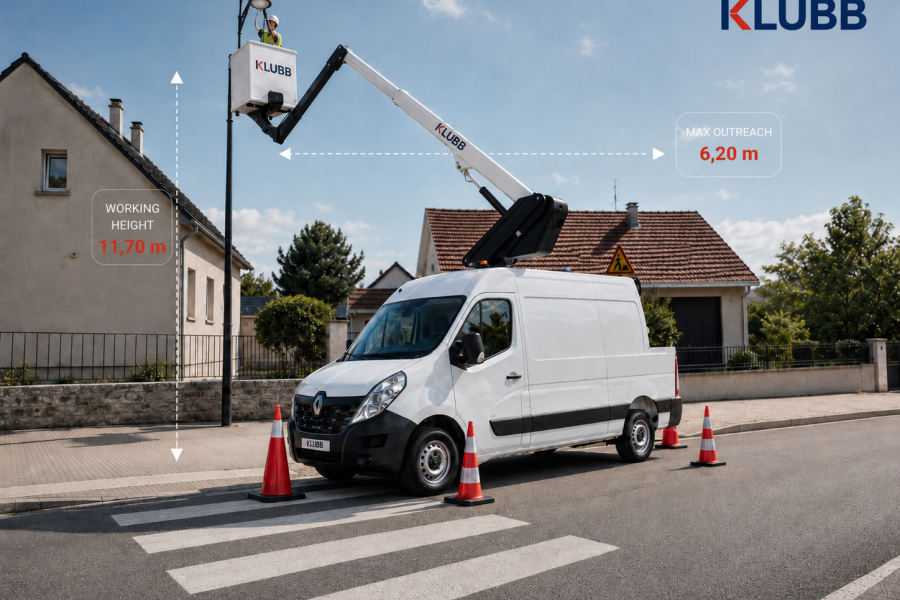
Working height answers a first question. How high do your teams need to operate from the basket without compromising their safety? Outreach raises another. How far from the vehicle do they need to reach in order to access the work area?
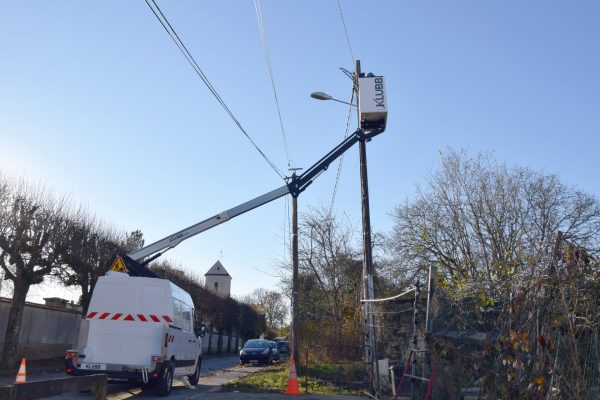
Let us be clear. These two figures do not replace the operational analysis. They extend it, refine it and give it practical meaning. They help you move from a requirement expressed on paper to a van-mounted platform configuration that genuinely reflects the realities of the field.
Take a straightforward example. A local authority may use the same vehicle for street lighting, road signage and building maintenance. It will often need a versatile platform, capable of covering several working scenarios within the same round.
In a more specialised context, a telecoms contractor will mainly seek to reach precise connection points, sometimes set back from the road or difficult to approach. In this case, outreach may carry greater weight in the decision, as it can reduce unnecessary vehicle repositioning.
Working height confirms the level you need to reach
Working height is still too often the first figure people look at on a technical data sheet. This is perfectly understandable. It gives an immediate indication of the van-mounted platform’s ability to reach equipment positioned at height.
However, if you rely on this figure alone, you may face unpleasant surprises later. You should always check whether the stated working height actually corresponds to the interventions your teams perform most frequently.
A van platform capable of reaching a greater height will not automatically be the most appropriate choice for your use case. If your teams mainly work between 8 and 12 metres, additional height may prove useful in certain situations, but it should never overshadow the other constraints imposed by the site.
For us, vehicle positioning is a decisive factor. If the van cannot be positioned close enough to the work area, height alone will not solve the problem. The basket may rise sufficiently high, yet still fail to reach the right working point under suitable and comfortable conditions.
This is why working height should be treated as a validation filter. It allows you to confirm the level that needs to be reached. But to understand whether the platform will be genuinely efficient and comfortable to use, you also need to consider how the vehicle can be positioned on site.
Useful outreach confirms the distance between the vehicle and the work area
Once you have confirmed the working height required, the next question is whether the basket can access the work area from the position where your van will actually be parked.
The outreach stated on a technical data sheet provides a useful first indication. Yet in day-to-day use, what matters most is useful outreach. In other words, the genuinely exploitable distance between the vehicle and the working point, once real site constraints have been taken into account.
This distinction is far from minor. Your van-mounted platform will not always be able to park directly beneath the work area. On public roads, in dense urban settings, in front of recessed façades, beside wide pavements, around trees or along cycle lanes, your teams often have to work with a distance dictated by the site itself.
Take a simple case. You need to work on a street light located on the other side of a cycle lane. On paper, the working height may appear sufficient. But if the van has to remain set back, the question changes. Can the basket still reach the street light from the vehicle’s actual position?
When the outreach is properly matched to the job, your teams spend less time searching for the right position. The basket can access the work area more smoothly, even when the vehicle cannot be parked exactly where you would ideally want it to be.
On repeated rounds, this becomes a significant advantage. The less your teams need to adjust the position of the van, the easier the intervention is to organise, the more comfortable it is to carry out, and the more consistent it becomes with your site constraints.
Why comparing two models by working height alone can be misleading
This is a point that deserves careful attention. Two van-mounted platforms may display very similar working heights, while offering quite different possibilities once they are used on site.
In practice, the difference often lies in a combination of factors, such as the type of boom, the presence of a jib or the rotation of the turret, rather than in working height alone.
Once again, a van-mounted platform offering greater working height may seem more attractive at first glance. Yet it will not always be the model that delivers the best value to your teams. If another platform approaches the work area more effectively, reduces repositioning or fits your rounds more closely, it may prove far more useful than a model that simply reaches higher.
This is why you should avoid comparing two van-mounted platforms solely on the basis of their maximum working height. That figure remains useful, of course. But it does not always explain how the machine will behave in your real operating conditions.
How to analyse working height and outreach before choosing a model
Before comparing technical data sheets, the most reliable approach is to return to your real field situations. Not an idealised intervention, but the cases your teams genuinely face.
- You can begin by looking at the heights most commonly reached. Do your teams generally work at 8 metres, 12 metres, 14 metres or higher? This first answer already helps you avoid choosing a machine for a maximum height that you will rarely use.
- You should then examine the real distance between the van and the work area. In some cases, the vehicle can be positioned fairly close. In others, it must remain set back because of a wide pavement, a cycle lane, a tree, a gate, a ditch or an obstacle present on site.
- The working environment also plays a major role. An intervention on a public road does not create the same constraints as an industrial site, a residential area or a recessed façade. The right choice will differ depending on whether your teams repeat the same operations regularly or move from one context to another throughout the day.
- Finally, you need to consider what the vehicle must carry. If your teams transport materials, tools or heavy equipment, working height and outreach cannot be assessed in isolation. The entire van-mounted platform configuration must remain consistent with the vehicle’s real use.
This approach helps you avoid choosing a machine purely for its maximum values. Instead, it enables you to select a van-mounted platform for what it will actually need to do every day, intervention after intervention.
The key logic to keep in mind
The logic is straightforward. Your trade defines the need. The site clarifies the constraints. Working height confirms the level to be reached. Outreach confirms the real distance between the vehicle and the work area.
It is this combination that allows you to choose a coherent van-mounted platform. Not merely a machine that looks impressive on a technical data sheet, but a platform suited to your teams, your rounds and the conditions in which you actually work.