





When you factor in narrow streets, traffic density, pedestrians and nearby electrical networks, working at height in urban environments is anything but straightforward. It is a constant balancing act.
As an operator, you also have to work quickly, remain precise and protect both your own safety and that of everyone around you at every stage. These constraints directly affect your organisation and your operational efficiency.
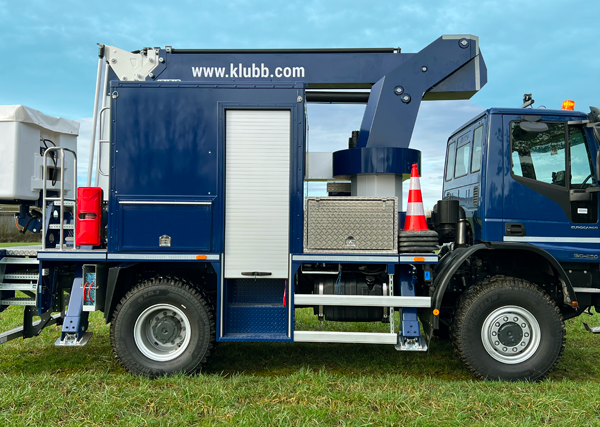
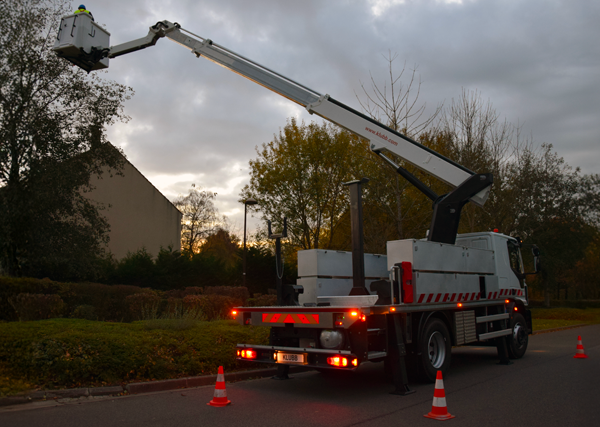
In these situations, working with chassis-mounted platforms, such as truck-mounted platforms, quickly shows its limits. Because of their larger footprint, these aerial platforms take longer to deploy and force you to carry out more manoeuvres once the basket is in position. That is lost time most teams cannot afford.
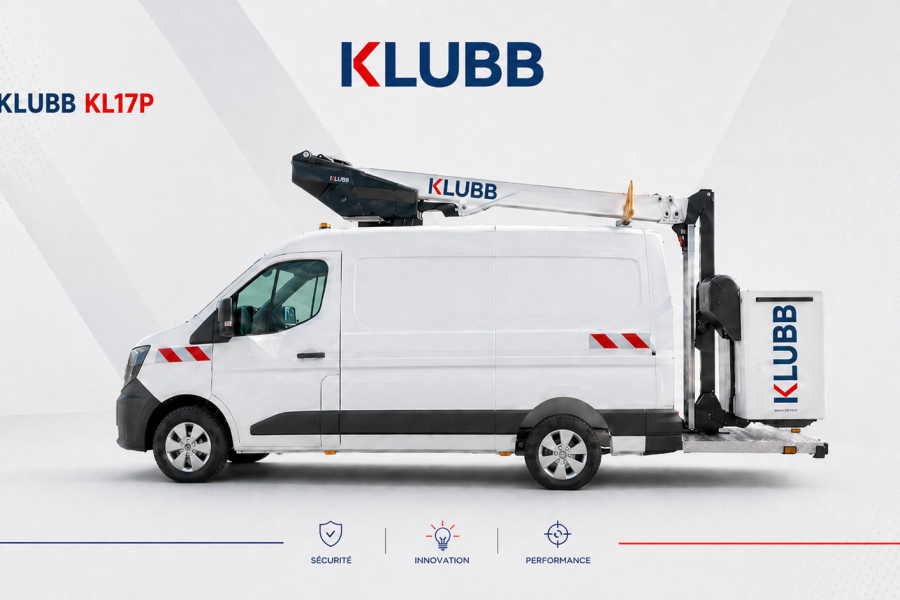
These constraints become far easier to manage when you choose KLUBB’s new KL17P van-mounted platform. Compact and mounted on a Renault Master L2H2 under 3.5 t, it has been designed for fast deployment and real working conditions on site.
When should you choose the KL17P van-mounted platform?
In practice, the KL17P van-mounted platform becomes the obvious choice when mobility and intervention speed are priorities.
For public lighting maintenance or CCTV camera installation, your teams often need to complete multiple operations in constrained environments, with little scope for closing traffic lanes for long periods.
Van-mounted platforms such as the KL17P help reduce set-up constraints while retaining sufficient working capacity for most operations.
Are there alternatives to the KL17P?
There are, of course, several alternatives to the KL17P. Each one responds to a specific operational need. On site, however, the decision depends on the balance you are seeking between compactness, speed of deployment, working height, outreach and ease of movement from one job to the next.
Light truck platforms, for example, are valued for their agility and everyday ease of use. They remain a relevant choice for many working-at-height operations. However, as soon as the requirement becomes more demanding in terms of height or outreach, light vehicle platforms can reach their limits more quickly.
Heavy-truck platforms offer greater working height and outreach than platforms mounted on chassis cabs under 3.5 t. This makes them a robust solution for certain applications, such as work on historic buildings. In return, their size and deployment time can be less favourable in tight urban areas.
Self-propelled platforms also make sense in their own configuration, particularly on fixed sites or in stable environments. They are less suited to situations where teams need to move frequently and work on several successive points.
KL17P. A technical and operational response to real site constraints
A mobile sub-3.5 t format
The sub-3.5 t format of the KL17P provides an immediate response to the constraints your teams face on site. It can be driven with a standard car licence, so you can mobilise crews more easily, without depending on specific driver profiles or additional administrative constraints.
This means more flexibility when organising rounds, especially when you need to respond quickly or reassign a team during the day. You gain responsiveness without making your logistics more complicated.
With a controlled unladen weight of around 3,100 kg with a full tank, this van-mounted platform retains optimised payload capacity. You can carry tools and equipment and work in good conditions, without having to compromise between mobility and load capacity. That balance is rarely achieved in this type of configuration.
Capacity adapted to working teams
On site, coordination, tool handling and area safety are part of everyday work. Working with two people is therefore often essential.
With a basket capacity of 250 kg, the KL17P responds directly to that requirement. Two operators can work at the same time with their equipment, without being restricted in their movements. This directly changes the way interventions can be organised.
Beyond the figure itself, this creates a real efficiency gain. Fewer trips back and forth, less dependency between operators and smoother task execution. Over a full working day, this can represent a significant time saving.
Work at height with precision
Height and outreach adapted to real use cases
The KL17P was not designed simply to go as high as possible. It was designed first and foremost to cover most urban working situations efficiently.
- With a working height of 17.3 m and outreach of up to 10.5 m, it provides access to complex areas without systematically repositioning the vehicle. That is where the real difference is made on site.
- Less repositioning means fewer manoeuvres, less lost time and less fatigue for operators.
- You gain continuity across your interventions.
A trade-focused reading of the machine’s capacities
Beyond raw performance figures, what matters most is how these capacities can be used.
Load chart management allows outreach to be adapted according to the weight in the basket. You can adjust positioning in real time according to the site configuration, while remaining within optimal safety conditions.
This avoids oversizing equipment “just in case”. You work with a machine that matches your real needs and make precise use of its capabilities. This is a more refined, more operational and often more cost-effective approach.
Reduce your intervention cycles with the KL17P van-mounted platform
Encouraging work on wheels
In many situations, especially medium-height operations, deploying stabilisers is not always necessary. In these configurations, the KL17P can work directly on wheels. On site, that changes a lot.
- You reduce set-up phases.
- You limit handling operations.
- You can complete successive interventions more quickly.
On a round involving several work points, the time saving becomes noticeable immediately.
Fast deployment
When the conditions require stabilisation, the KL17P remains consistent with the same speed-focused logic.
Automatic stabilisation allows fast deployment without operator intervention. Everything is designed to simplify set-up and secure the intervention from the first few minutes.
The home function allows the basket to be returned to its initial position in a single movement. It may sound like a small detail, but at the end of an operation, when the next task has to follow quickly, this type of feature makes a real difference.
You save time on every “non-productive” phase, including set-up, stowage and repositioning. Your efforts are therefore focused on what truly matters. The work at height itself.