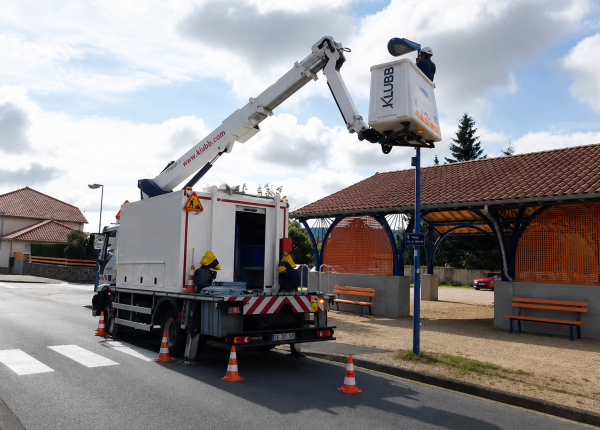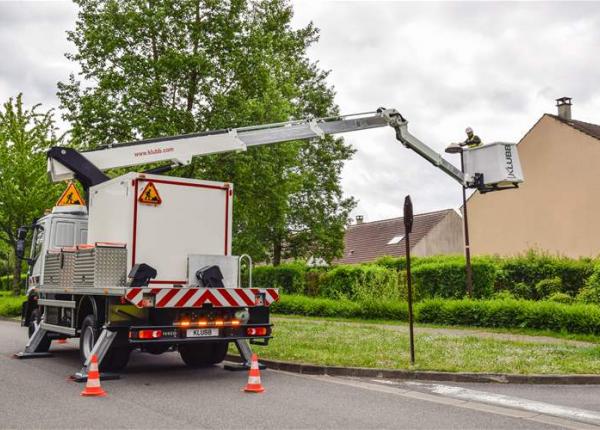






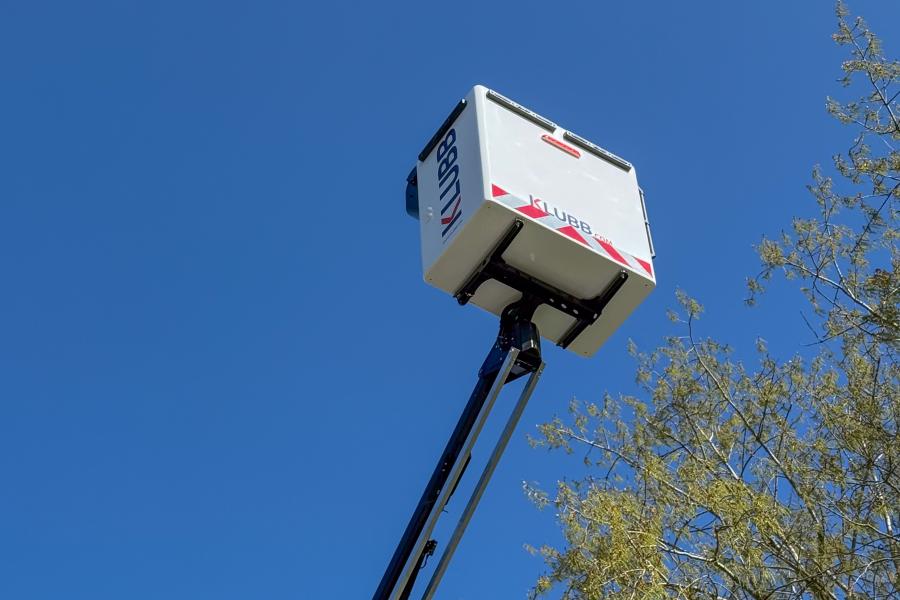
When selecting an aerial work platform, working height, horizontal outreach and basket load capacity are often the first specifications you consider. Understandably so, as these characteristics directly determine what your teams can achieve on site.
However, the material used to manufacture the platform basket also deserves careful consideration. It influences durability, maintenance requirements, resistance to environmental conditions and, in certain circumstances, the electrical safety of the equipment. At KLUBB, we offer both aluminium and fibreglass baskets, each designed to meet different operational requirements.
The purpose of this guide is not to establish whether aluminium is inherently better than fibreglass. Instead, we examine the properties of each material and explain how they relate to your industry, operating conditions and the risks associated with working at height.
Aluminium and Fibreglass: Two Materials with Different Properties
Before examining how these materials affect the operational performance of an aerial work platform, it is worth understanding their respective characteristics. Aluminium and fibreglass respond differently to moisture, corrosion, impacts, ageing and electricity.
These differences become particularly significant when working at height in environments such as:
- Wet or rainy conditions.
- Urban areas.
- Industrial facilities.
- Locations close to electrical installations.
The basket material should therefore be considered both a performance factor and an important aspect of equipment safety.
Aluminium: A Lightweight, Durable and Conductive Material
Aluminium is widely used across industrial applications thanks to several valuable characteristics:
- Good resistance to corrosion and oxidation.
- High electrical and thermal conductivity.
- Low density.
- High reflectivity.
- Excellent ductility.
- Relatively high mechanical strength.
- Comparatively moderate material costs.
These properties are documented by European Aluminium, the association representing the European aluminium industry.
Its corrosion resistance is largely attributable to the thin oxide layer that forms naturally on the metal's surface. This protective layer helps prevent further deterioration, contributing to aluminium's durability under a wide range of environmental conditions.
For aerial work platforms, this characteristic has clear practical advantages. Operators frequently work outdoors, exposing the basket to rain, humidity, temperature fluctuations, dust and other environmental factors. Aluminium therefore provides a durable solution, provided that the equipment is appropriately designed and maintained.
However, one characteristic deserves particular attention: aluminium is highly conductive, both electrically and thermally.
This makes it unsuitable as an insulating barrier when working close to high-voltage power lines or other energised electrical installations.
Aluminium baskets can be particularly appropriate for conventional working-at-height applications, but they do not provide protection against electrical hazards. If your teams operate near electrical networks, basket selection must form part of a broader assessment of the equipment and its intended operating conditions.
Fibreglass: A Strong, Lightweight and Electrically Insulating Composite
Fibreglass belongs to the family of composite materials. It is also commonly referred to as glass-reinforced plastic (GRP) or glass-fibre reinforced polymer (GFRP).
The material combines glass fibres with a polymer resin to produce a structure that is lightweight, rigid and mechanically resistant.
These composites are valued for their favourable strength-to-weight ratio. The glass fibres provide reinforcement, while the resin binds the structure together, protects the fibres and gives the finished component its shape.
The resulting properties depend on several factors, including the resin formulation, fibre type, material thickness, manufacturing process and surface finish.
Fibreglass is also valued for its resistance to corrosion. Unlike metals, it does not rust, making it particularly suitable for applications exposed to moisture, chemicals and aggressive environmental conditions.
Research supported by the European Commission through its CORDIS programme highlights the corrosion resistance, durability and electrical insulation properties of glass-fibre reinforced polymers.
In most conventional formulations, fibreglass composites are also poor conductors of electricity and heat.
However, their electrical behaviour depends on the precise composition of the material. Additives such as metallic particles or conductive fibres can significantly alter these characteristics.
This distinction is essential when selecting equipment intended for work near electrical installations.
A fibreglass basket, an electrically insulated basket and a fully insulated aerial work platform are not necessarily equivalent.
Although fibreglass has useful insulating properties, the electrical protection provided by an aerial work platform depends on the design of the complete machine.
The basket, boom, insulating components, any protective liners, dielectric testing, maintenance procedures and applicable standards must all be taken into account.
Understanding the Difference Between Material Properties and Actual Equipment Performance
The intrinsic properties of a material provide useful information, but they cannot independently establish how an aerial work platform will perform under real operating conditions.
Aluminium may be lightweight, durable and corrosion-resistant. Fibreglass may offer low electrical conductivity and excellent resistance to aggressive environments.
However, these characteristics must always be considered in relation to the equipment's design and condition.
For an aluminium basket, this means examining the alloy, surface treatments, joints, fastenings, mechanical loads and operating environment.
For a fibreglass basket, additional attention must be given to the resin system, material thickness, surface condition, absence of cracks, cleanliness and ageing of the composite structure.
European Commission-funded research into electrically conductive composite structures demonstrates how incorporating conductive materials into fibre-reinforced composites can alter their electrical behaviour.
Electrical properties therefore depend on the precise composite formulation and must be considered alongside the material's condition throughout its service life.
This distinction becomes particularly important when dealing with insulated aerial work platforms.
The high-voltage tests we regularly carry out demonstrate that dielectric assessments can involve several components of the machine, including the boom and hydraulic fluids.
Consequently, the insulating performance of an aerial work platform depends on a combination of appropriately designed, tested and maintained components, rather than the presence of a fibreglass basket alone.
How Basket Materials Affect the Performance of an Aerial Work Platform
In everyday operation, an aerial work platform must withstand a range of mechanical and environmental stresses.
It must accommodate one or more operators, their tools and, in some cases, additional equipment. It must also remain stable, undergo regular inspections and retain its required performance characteristics throughout its service life.
The basket is therefore a critical functional component.
Its material should never be assessed independently of the complete machine configuration, including working height, horizontal outreach, permissible platform load, vehicle chassis, stabilisation system and operating conditions.
Weight, Payload and Basket Load Capacity
Weight is a particularly important consideration for vehicle-mounted aerial work platforms.
It affects the remaining vehicle payload, chassis selection, equipment configuration and, potentially, the range of applications for which the machine is suitable.
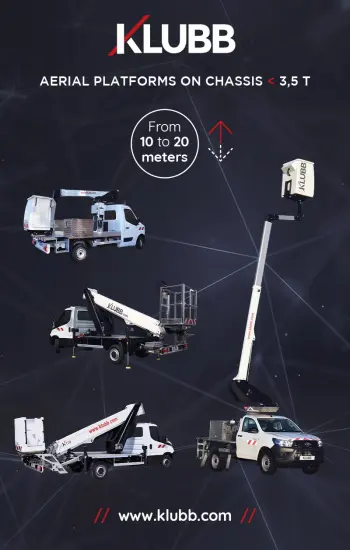
This is especially relevant for vehicles with a restricted gross vehicle weight (GVW), such as van-mounted or chassis-mounted platforms up to 3.5 tonnes.
Every component contributes to the overall weight and balance of the machine.
The basket, boom, vehicle chassis, outriggers and additional equipment must all be taken into account.
Basket material is therefore a useful selection criterion, but it cannot replace a comprehensive assessment of the machine's complete configuration.
Corrosion Resistance and Outdoor Applications
Aerial work platforms rarely operate under ideal environmental conditions.
Depending on your industry, they may be exposed to rain, humidity, dust, airborne contaminants, frequent washing or particularly aggressive atmospheres.
Aluminium performs well under many of these conditions thanks to its naturally occurring protective oxide layer.
As explained by European Aluminium, this layer contributes to the metal's corrosion resistance and long-term durability.
Fibreglass also offers excellent corrosion resistance, alongside its low weight and generally non-conductive properties.
However, it would be misleading to assume that one material is automatically superior to the other in outdoor environments.
Both aluminium and fibreglass can provide suitable solutions.
The most relevant differences depend on your intended application, electrical hazards, machine design and maintenance requirements.
Maintenance, Inspection and Ageing
An aluminium basket requires particular attention to deformation, cracks, fastenings, welds, impact damage and signs of localised corrosion.
We therefore recommend checking that the basket structure retains its mechanical integrity throughout the equipment's service life.
Fibreglass baskets require a different inspection approach.
Operators and maintenance teams should pay particular attention to impact damage, deterioration of the protective coating, moisture ingress, cleanliness and surface condition.
These inspections become especially important when the basket forms part of an insulated equipment configuration.
For insulated aerial work platforms, inspection requirements extend beyond visual checks alone.
Additional electrical testing, inspections and maintenance procedures may be required according to the manufacturer's specifications and the applicable standards.
When Should You Choose an Aluminium Basket?
An aluminium basket is a practical choice for conventional working-at-height applications.
Typical uses include building maintenance, construction, industrial operations, signage installation, urban infrastructure maintenance, street lighting and telecommunications.
Where the operating conditions do not require a specifically insulated equipment configuration, an aluminium basket can provide a suitable solution.
However, it is important to remember that aluminium is electrically conductive.
It does not protect operators from electrical hazards.
If your teams work near overhead power lines, energised networks or electrical installations, basket material cannot be selected solely on the basis of convenience, weight or durability.
As highlighted by the European Agency for Safety and Health at Work (EU-OSHA), working at height near overhead power lines presents risks of electric shock through direct contact or insufficient separation from energised conductors.
Appropriate risk assessments, safe working distances, equipment selection and operating procedures are therefore essential.
When Should You Choose a Fibreglass Basket?
Fibreglass becomes particularly relevant when your operating environment requires careful consideration of electrical insulation.
It is commonly incorporated into certain insulated aerial work platforms designed for operations near electrical distribution networks and, where specifically designed and authorised, live electrical installations.
However, an important distinction must be made.
A fibreglass basket does not, by itself, make an aerial work platform electrically insulated.
Electrical protection depends on the design and condition of the entire machine.
This may involve the basket, boom, insulating sections, protective liners, dielectric testing, maintenance procedures, operating instructions and applicable standards.
The European standard EN 280-1:2022 addresses the design, construction, stability and safety requirements of mobile elevating work platforms, but does not itself cover the hazards arising from work on external live electrical systems.
Operations involving electrical hazards therefore require additional consideration of the equipment's verified insulating capabilities and the relevant electrical safety requirements.
Which Professional Applications Influence Basket Selection?
Choosing between aluminium and fibreglass becomes easier when you begin with the actual application.
An aerial work platform used for routine street lighting maintenance may face very different constraints from one designed for operations close to electrical distribution networks.
| Application | Potential equipment choice | Selection considerations |
|---|---|---|
| Building maintenance | Aluminium basket | Conventional applications requiring low weight, durability and routine maintenance |
| Urban signage | Aluminium basket | Frequent operations, outdoor exposure and manoeuvrability requirements |
| Industrial maintenance without electrical hazards | Aluminium basket | Mechanical resistance, regular use and potentially demanding environments |
| De-energised street lighting maintenance | Aluminium or specialised configuration following risk assessment | Depends on the actual electrical environment and working procedures |
| Telecommunications | Aluminium basket or insulated MEWP, depending on conditions | Requirements vary according to the network, site and proximity to energised equipment |
| Work near overhead power lines | Fully insulated MEWP where required by the risk assessment | Basket material alone is insufficient; the entire machine must be assessed |
| Electrical networks and utilities | Insulated MEWP meeting the applicable requirements | Appropriate design, testing, maintenance and operating procedures are essential |
How to Make the Right Choice
Your decision should begin with the practical conditions your teams encounter.
Basket material only becomes a meaningful selection criterion when considered alongside the working environment, level of risk and organisation of your operations.
| Selection criterion | Aluminium basket | Fibreglass basket |
|---|---|---|
| Primary applications | Conventional working-at-height operations | Applications involving potential electrical hazards |
| Weight | Lightweight | Lightweight, depending on composite construction |
| Corrosion resistance | Good resistance thanks to the natural oxide layer | Very good resistance when the composite is properly designed and protected |
| Electrical properties | Conductive | Generally non-conductive in suitable configurations |
| Maintenance | Deformation, welds, fastenings and localised corrosion | Impacts, cracks, surface coating, moisture ingress and cleanliness |
| Typical applications | Maintenance, construction, industry and urban infrastructure | Electrical networks, utilities, overhead power lines and appropriately authorised live-line operations |
| Main consideration | Does not provide electrical protection | Does not independently make the entire machine electrically insulated |
Choosing the Right Basket Starts with Understanding Your Application
Aluminium and fibreglass baskets address different operational priorities.
Aluminium is particularly well suited to conventional applications where a lightweight, durable and corrosion-resistant solution is required within a versatile aerial work platform.
Fibreglass offers valuable characteristics in environments where electrical insulation is an important consideration. However, these material properties must always be assessed as part of the machine's complete design and verified safety performance.
Ultimately, the most appropriate choice depends on your industry, operating environment, level of risk, required basket load capacity, equipment configuration and applicable standards.
Discussing these requirements with a specialist remains the most reliable way to identify an aerial work platform configuration genuinely suited to your operations.